
The creation of a new generation of transparent hybrid fire-resistant hydrogel materials in particular refractory glass structures on polymer-mineral basis has great social significance as well as their production establishment and implementation in practice. This class of material allow to increase the time for evacuation and save the most valuable thing – human life – in the event of a fire.
This study proposes the formation of fire-resistant glass units using polymer-mineral (hybrid) hydrogel. Under the influence of extremely high temperatures (above 100°C), this material changes its structure, forming a porous layer that prevents glass deformation and the appearance of fractures. This technology effectively inhibits the spread of fire and high temperatures, providing a reliable level of fire protection and meeting modern safety standards.
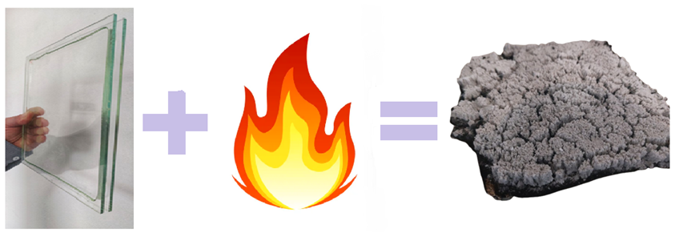
The technology for obtaining the fire-resistant layer is based on the hybrid hydrogel synthesis that combines the properties of mineral polysilicate hydrogel and polymer hydrogel (polyacrylamide copolymer crosslinked with poly-N-(hydroxymethyl)acrylamide-co-acrylic acid-co-N,N-methylenebisacrylamide).
A method for the controlled synthesis of branched copolymers of acrylamide, acrylic acid and N,N-methylenebisacrylamide has been developed, the aqueous solutions of which in a wide range of concentrations (up to 30%) obey the laws of flow of Newtonian liquids, which makes it possible to create low-viscosity pouring compositions based on them. The obtained copolymers have been characterized by IR and PMR spectroscopy methods and it has been established that copolymers containing no more than 15 mol% of acrylic acid units are suitable for obtaining transparent solutions in the presence of polyvalent metals (magnesium, aluminum) cations. On the basis of the selected copolymers using polymer reactions of transformations and intermolecular structuring, polymeric hydrogels of various compositions were obtained, the regularities of their synthesis were investigated and the obtained material was characterized. Correlation analysis of experimental data (crosslinking density, light transmittance, swelling behavior, gel fraction, mechanical properties) was carried out. Graphical and mathematical relationships describing polycondensation reactions in the selected system and properties of polymer hydrogels were obtained.
The conditions for obtaining polymer hydrogels with optimal properties have been determined for their use as a component of the polymer part of a hybrid hydrogel composition in the production of fire-resistant glazing units. Testing of the obtained fire-resistant glazing units filled with hybrid hydrogel demonstrates an increase in fire resistance properties compared to existing analogs.