Pollution of the environment with heavy metals has consequences for public health due to their toxicity, their longevity, their rapid migration in aquatic ecosystems and their ability to bioaccumulate in organisms entering the food chains [1]. Various technologies are used to purify polluted water, such as sedimentation, flocculation, evaporation, membrane technology, etc. However, the most promising is still the adsorption method using various sorbents, such as activated carbon, zeolites, polymers, functionalized silicon, clay, etc., since it is considered one of the most effective and simplest. Among them, biopolymers such as chitosan and cellulose are particularly in demand due to their non-toxicity and biodegradability, their widespread use and natural origin, regenerability and modifiability, low-cost and biocompatibility [2-3]. This work aims to study the sorption capabilities of synthesised magnetic chitosan (MCN) in various aqueous media.
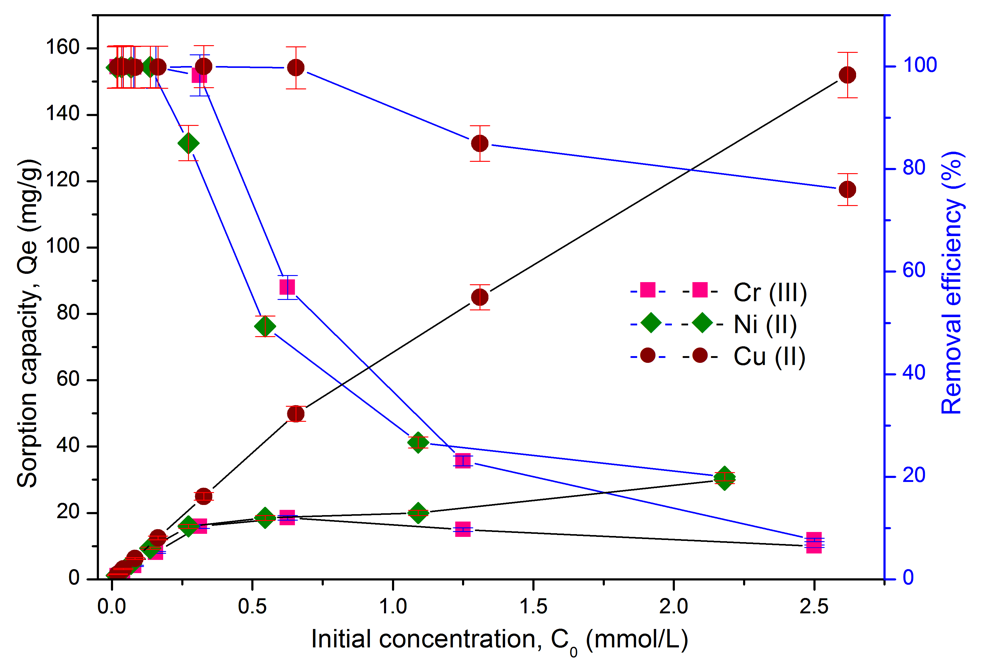
Synthesised MCNs were characterised using the XRD, SEM, FT-IR and Mössbauer methods to verify the composition, morphology and magnetic properties. Experiments were carried out to investigate the dependence of the adsorption of Cu (II), Ni (II) and Cr (II) on the concentration, removal efficiency (Fig. 1), pH value and contact time. In addition, the sorption potential of MCNs was tested on water samples from different aquatic ecosystems (Baltic Sea, Balsys Lake and Neris River) using the trace radionuclides (\(^{152}\)Eu and \(^{60}\)Co). A gamma-spectrometer was used for concentration determination in the traced samples and ICP-OES for heavy metals. The sorption data obtained were analyzed with the isothermal studies, and sorption kinetic parameters for MCNs were calculated.
The results obtained indicate that the MCN adsorbent can be considered quite effective for the removal of heavy metals. It can be used for the pre-concentration of radionuclides and can be easily separated from the medium/sample using a magnet.