
The broad and smooth emission bandwidth of ytterbium-doped calcium gadolinium aluminum oxide (Yb:CaGdAlO4; Yb:CALGO) crystals makes them essential for developing high-power and ultrashort pulse laser technologies. Yb:CALGO is a good material because of exceptionally broad gain bandwidth. This allows to amplify ultrashort, femtosecond pulses. The high thermal conductivity of Yb:CALGO also guarantees efficient heat dissipation during high-power operation, preserving performance stability. Because of these characteristics, Yb:CALGO crystals are perfect for industrial operations requiring a high degree of power and precision, as well as scientific research and medical applications [1–3]. Yb:CALGO powder was synthesized from corresponding metal nitrates using the sol-gel method. The phase purity of the powder samples was confirmed using X-ray diffraction (XRD) analysis. The powder was pressed into rods and then used to grow the crystal by the optical floating zone (OFZ) method. Scanning electron microscopy (SEM) images were taken to determine the morphology of the crystal. SEM images revealed defects on the crystal cut surface. On the other hand, it showed a homogenous element distribution. ICP-OES measurement showed that both the powder and the single-crystal had correct stoichiometry, indicating that the melting process did not alter it. The luminescence properties were also investigated, demonstrating the typical emission and excitation spectrum corresponding to ytterbium electron transitions. This study demonstrated that the OFZ method is suitable for growing Yb:CALGO crystals. However, the crystal exhibited some defects, making it unsuitable for practical use as a laser core. This highlights the need for further research to optimize the crystal growth process. 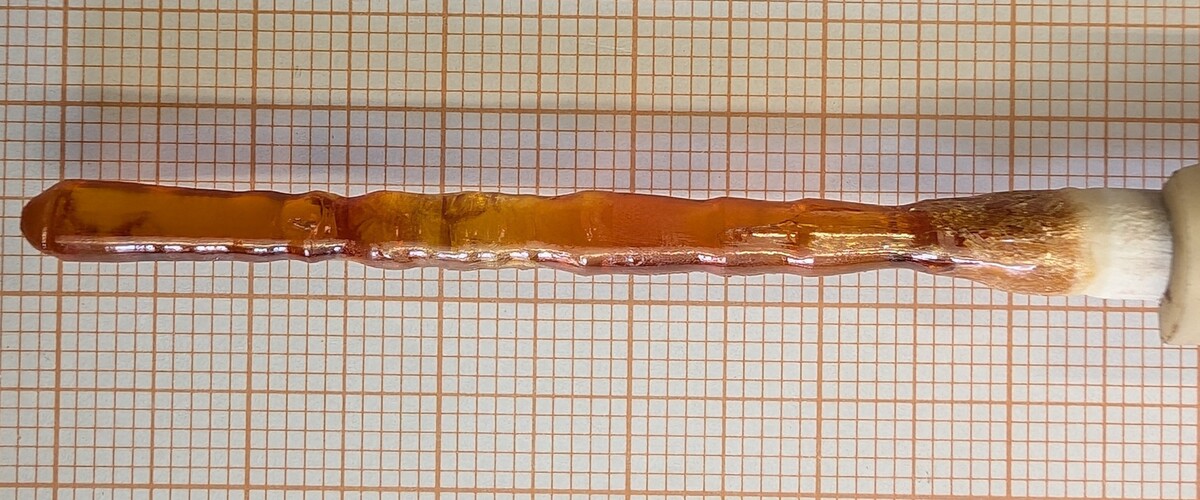
GROWTH OF YB:CALGO CRYSTAL BY OPTICAL FLOATING ZONE METHOD
Domantas Černius1, Monika Skruodienė2, 3, Anatolijs Šarakovskis3, Ekaterina Pomjakushina4, Ramūnas Skaudžius1
1 Department of Inorganic Chemistry, Vilnius University, Naugarduko 24, LT-03225 Vilnius, Lithuania
2 Department of Chemical Engineering and Technology, Center for Physical Sciences and Technology, Saulėtekio av. 3, LT-10257 Vilnius, Lithuania
3 Institute of Solid State Physics, University of Latvia, 8 Kengaraga str., LV-1063 Riga, Latvia
4 Laboratory for Multiscale Materials Experiments, Paul Scherrer Institut, CH-05232 Villiginen PSI, Switzerland
[1] J. Yang, Z. Wang, J. Song, R. Lv, X. Wang, J. Zhu, Z. Wei, Diode-pumped 10 W femtosecond Yb:CALGO laser with high beam quality, High Power Laser Science and Engineering 9 (2021).
[2] H. Wang, J. Pan, Y. Meng, Q. Liu, Y. Shen, Advances of Yb:Calgo laser crystals, Crystals (Basel) 11 (2021).
[3] S. Slimi, H. Yu, H. Zhang, C. Kränkel, P. Loiko, R.M. Solé, M. Aguiló, F. Díaz, W. Chen, U. Griebner, V. Petrov, X. Mateos, Growth, structure, spectroscopic, and laser properties of Ho-doped yttrium gallium garnet crystal, Opt. Express 33 (2025) 2529–2541.