
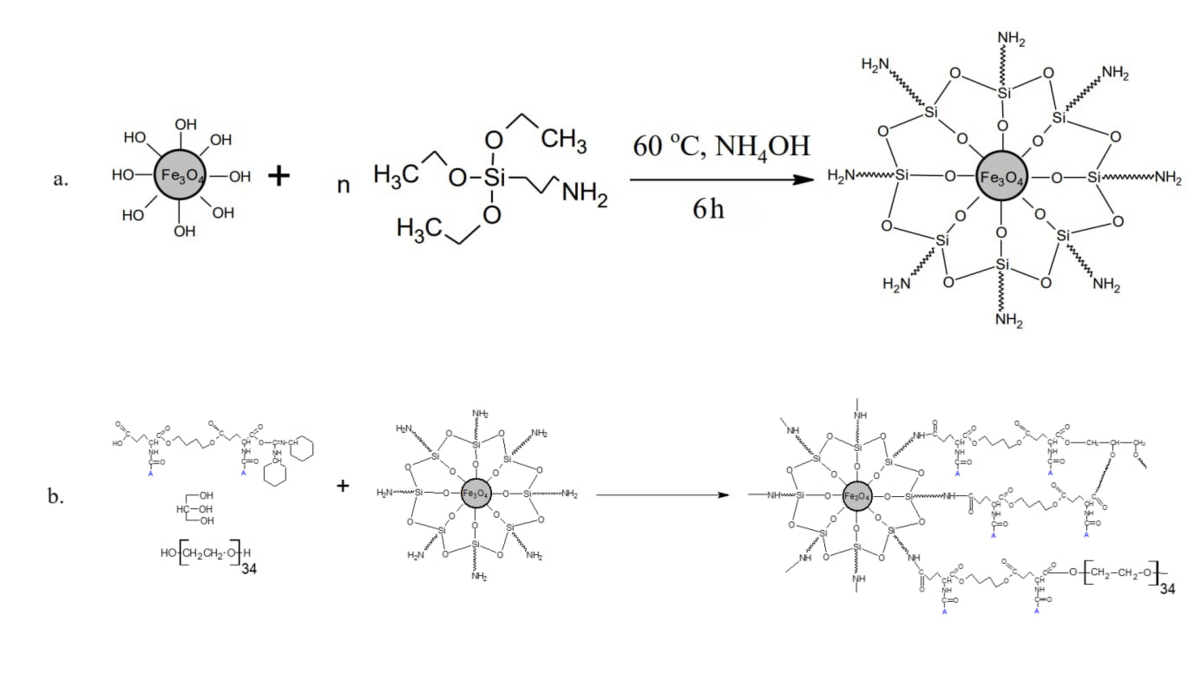
Nowadays, hydrogels are widely used as carriers of drugs and biologically active substances. A separate application of hydrogels is their use as components for drug delivery devices. In tissue engineering, hydrogels are used as implants, for the manufacture of biosensors and in cancer therapy. To control hydrogels within the body and facilitate their removal, systems incorporating magnetically controlled particles - such as Fe\(_{3}\)O\(_{4}\) and CoFe\(_{2}\)O\(_{4}\) and others- are actively being developed. Magnetically controlled hydrogels are obtained by three different methods: mixing, precipitation and grafting to the surface [1]. In this work, magnetite was used to graft the polymer matrix, the surface of which was modified with 3-aminopropyltriethoxysilane (APTES) to localize reactive amino groups on the surface of magnetite. A schematic representation of magnetite surface modification is shown in Fig. 1a.
Surface-modified magnetite was used for grafting N-stearoylglutamic acid polyester along with oxyethylene and oxypropylene diols in the presence of glycerol via the Steglich reaction at 15°C. The principle scheme of grafting polyester to the surface of magnetite is shown in Fig. 1b. The polyester components were chosen primarily for their non-toxicity, as well as for the non-toxicity of their biodegradation products.
The degree of Fe\(_{3}\)O\(_{4}\)/APTES surface modification was estimated using IR spectra at different molar ratios of the modifier to magnetite. Based on the obtained spectra, it can be concluded that a ratio of 13:1 (APTES/Fe\(_{3}\)O\(_{4}\))) is the minimal sufficient amount for surface modification. The formation of a cross-linked monomolecular layer of polyester on the surface of modified magnetite occurs at a ratio of 41:44 (APTES/Fe\(_{3}\)O\(_{4}\)), ensuring 31.8% grafting of polyester to the magnetite surface. The obtained magnetically controlled polyesters were used for sorption of α-amylase into the grafted polyester matrix as a model sample. The incorporation of the enzyme preparation into the grafted polyester matrix was confirmed using thermogravimetric analysis. The activity of the enzyme preparation immobilized in the polyester matrix grafted to the magnetite surface was carried out according to the classical method.