Methane is a potent greenhouse gas and developing new methods to measure the emittance of methane from various natural and industrial sources is most important, in addition to being able to detect methane gas leaks from pipelines and natural gas pipes near and in homes, preventing wasting of the gas and uneccesary emissions. This study employed the use of a 3270nm 15mW NanoPlus Distributed Feedback (DFB) laser with an alternating power output around the given frequency achieved by a 100Hz triangle wave signal oscillating from 0mV to 250mV, which is from a signal generator is sent to the laser control module. As the current supplied to the laser varies, the emitted wavelength also changes up to 9 nm. This is enough to move the wavelength in and out of the absorption range, which is visible by a local distortion in the triangle signal. The different absorption lines of methane and water vapor allow to distinguish between the two molecules. The laser wavelength was also manipulated via changing the temperature of the thermoelectric cooler, combined with current variation, this allows to modify the laser wavelength by as much as 16 nm, enough to investigate multiple methane and water vapor absorption lines.
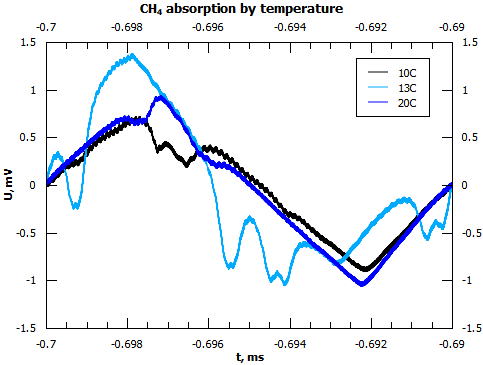
Fig. 1. Response signal under different conditions
The optimal laser temperature for detection of methane and water vapor was determined by shifting the temperature of the laser and observing the distortions of the triangle wave. Note – only the most prolific methane absorption examples have been graphed. The selected laser temperature for further studies is 13°C, which was chosen for its drastically distorted triangle wave signal (Fig. 1) Calibration was performed in a cuvette with varying pressures and concentrations of methane gas. Using the following equation \(U = {U_{0}(1 - e}^{- n \bullet \sigma \bullet L}\)), the concentration n of methane can be calculated from the size of the distortion of the detected triangle wave. Calibration using a known concentration of CH4 in a cuvette was performed at various pressures and concentrations. It was discovered that the lowest reliably detectable concentration for 1 meter of optical path was 100 ppm.
The experiment setup was moved outside and measurements were attempted above a grey water sewage access well. Control measurements were run with the manhole cover lowered, which showed clear water vapor absorption and demonstrated the system‘s ability to work in an outdoor environment. Methane was not detected with the cover removed, even as multiple measurements were repeated. As the optical path for the system outside was 5 meters, this indicates the CH4 concentration was below 20 ppm.
[1] [1] Vurgaftman, I et al. (2015). Interband cascade lasers. Journal of Physics D: Applied Physics. 48.123001
[2] [2] Du, Zhenhui et al. (2019). Mid-Infrared Tunable Laser-Based Broadband Fingerprint Absorption Spectroscopy for Trace Gas Sensing: A Review. Applied Sciences. 9. 338.
[3] [3] Gardiner, Tracy et al. (2010). A lightweight near-infrared spectrometer for the detection of trace atmospheric species. Review of Scientific Instruments. 81. 083102
[4] [4] Myhre, G. et al. 2013: Anthropogenic and Natural Radiative Forcing. In: Climate Change 2013: The Physical Science Basis. Contribution of Working Group I to the Fifth Assessment Report of the Intergovernmental Panel on Climate Change