New advances in hydrogen fuel cells technology play a significant role in addressing environmental problems, caused by traditional (combustion) methods of electrical energy generation. Solid oxide fuel cells (SOFCs) are capable of directly transforming chemical energy into electricity with high efficiency, fuel flexibility and low environmental impact, offering clean energy conversion [1, 2]. The electrolyte is fundamental to the operation of SOFC, as it serves to separate the fuel at the anode from the oxidant at the cathode. To achieve high efficiency, the electrolyte must possess high oxygen ion conductivity, minimal electronic conductivity and chemical stability under operational conditions [3]. However, using traditional electrolytes, such as yttria-stabilized zirconia (YSZ), these properties are only observed at high temperatures (800-1000 °C), which leads to material degradation and reduced longevity [4]. The previous research studies indicate that ceria-based electrolytes, especially co-doped with rare earth elements - samarium (Sm\(^{3+}\)) and gadolinium (Gd\(^{3+}\)), enhance oxygen ion conductivity and maintains high efficiency at intermediate temperatures (500-700 °C).
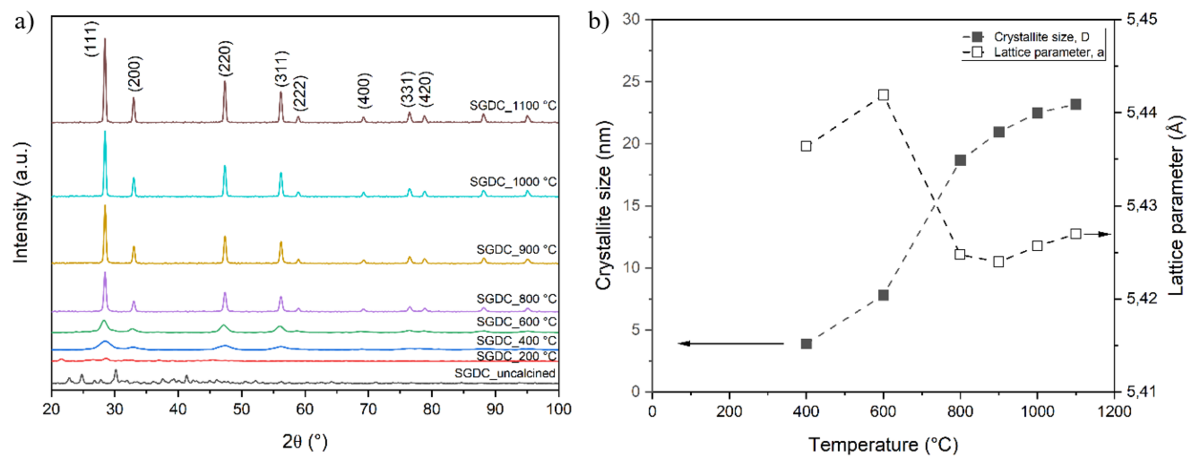
This research focuses on samarium and gadolinium co-doped ceria (SGDC), as an alternative electrolyte material. SGDC nanopowders with stoichiometric formula (Ce\(_{0.825}\)Sm\(_{0.0875}\)Gd\(_{0.0875}\)O\(_{2-}\)δ) were synthesized using co-precipitation synthesis method. The XRD results of co-doped ceria nanopowders confirmed fluorite-type cubic structure (Fig. 1 a)). Calculated crystallite sizes and lattice parameters of SGDC nanopowders as a function of temperature are plotted in Fig. 1 b). The average lattice parameter is 542.9 pm and crystallite size is 23.2 nm at higher calcination temperatures. The morphological properties of the pressed ceramic pellets were examined using scanning electron microscopy (SEM). The impedance spectroscopy (IS) showed an increase in the total resistance of ceramics.