
Carbon nanoparticle composites have garnered notable scientific and industrial interest due to a wide range of filler particle options and their corresponding electrical, thermal, and mechanical properties. However, agglomeration of filler particles remains a crucial technological consideration for the applicability of these materials, as it depends on the type and amount of fillers [1].
Low frequency noise measurement enables the investigation of electrical characteristics, as well as the quality of composite materials, since a greater presence of structural defects typically results in higher noise level [2]. For applications in electronics, 1/\(f\) noise is particularly significant due to the limit it imposes on the sensitivity and selectivity of electrical sensors [3].
Resistivity and low frequency (10 Hz – 20 kHz) noise characteristics of hybrid epoxy composites with multi-walled carbon nanotubes (MWCNTs) and carbonized nickel (Ni@C) were investigated at room temperature and in the temperature range of (75–365) K. Composites were prepared via dispersion of epoxy and different concentrations of MWCNTs (0, 0.09 vol.%) and Ni@C (0, 0.025, 0.2, 5, 15, 25, and 30 vol.%).
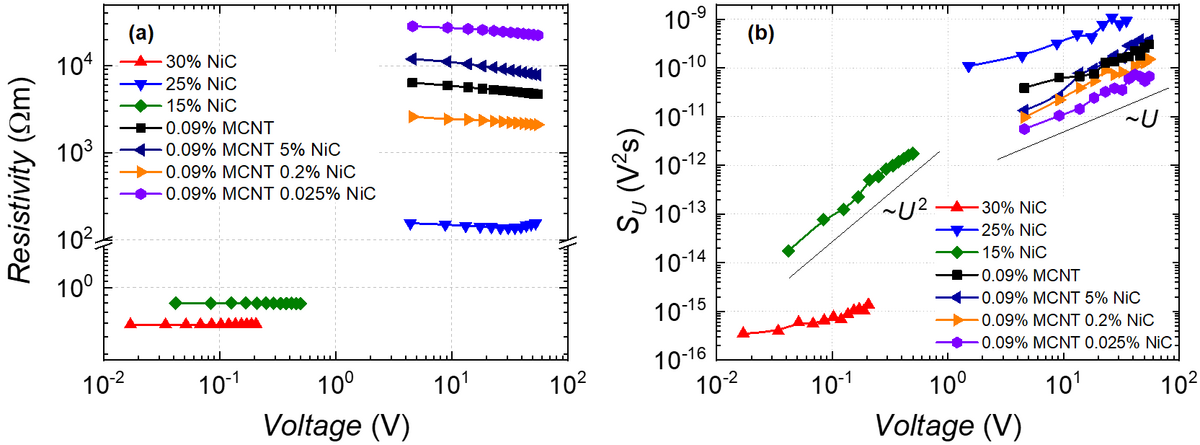
Low frequency noise spectra are primarily of 1/\(f\) type. In the proportionality of voltage fluctuation spectral density to voltage \(S_{U} \sim U^{b}\), exponent \(b\) is close to 1 for most of the studied composite samples. This is indicative of an increased contribution of tunneling processes to the conductivity in the composite (Fig. 1b).