Soybean (Glycine max) is a leguminous crop highly valued for its rich protein content, natural ability to fix atmospheric nitrogen, and diverse applications in food, feed, and industry, making it a key component of global agriculture and sustainability initiatives. In the Nordic and Baltic regions, efforts are increasingly directed toward boosting local protein production and reducing reliance on imports, with soybean cultivation emerging as a viable solution. However, successful cultivation in soils lacking native Bradyrhizobium strains—essential for biological nitrogen fixation (BNF) through nodule formation—remains a challenge. This study investigated soybean N₂-fixation potential using inoculants containing Bradyrhizobium japonicum strains, aiming to enhance BNF through seed inoculation, a standard practice that serves as an alternative to mineral nitrogen fertilizers.
Field experiment was carried out in Lithuanian Research Centre for Agriculture and Forestry (LAMMC) in Akademija (55°24′ N, 23°51′ E), Kėdainiai district. Field trials were performed in organic fields, which have been managed organically for many years, with no additional irrigation, pesticides, or chemical inputs. BNF efficiency was evaluated measuring nitrogen stable isotope ratios in bean, shoot and stem samples using Thermo Flash EA 1112 elemental analyser connected to Thermo Scientific Delta V Advantage isotope ratio mass spectrometer (EA-IRMS) in Center for Physical Sciences and Technology (FTMC). Various biological parameters, such as yield, plant height, nodule number and mass, as well as protein and lipid contents, were analyzed.
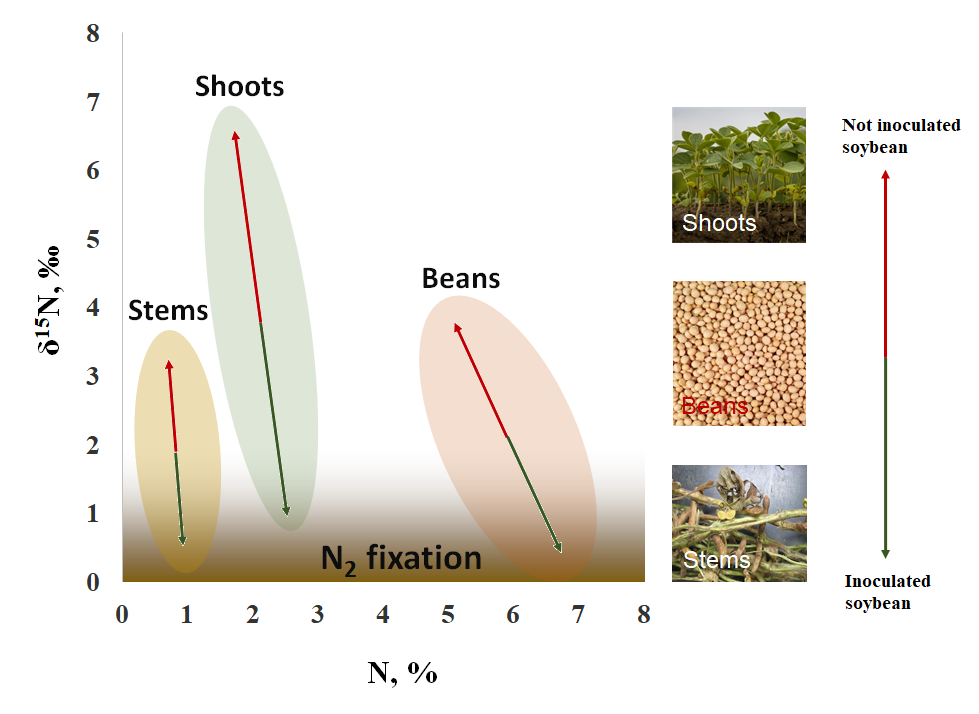
The number of nodules per plant affected both the nitrogen isotopic ratio and nitrogen content in soybean samples. Higher biomass displayed a slight correlation with the nitrogen isotopic ratio. Seed yield was linked to nodule weight and nitrogen content in seeds, while protein content correlated with the number of nodules per plant. Tendencies in nitrogen isotopic values and nitrogen contents in different plant parts of soybean inoculated and not inoculated with Bradyrhizobium japonicum are shown in Fig. 1. The study demonstrated that soybean inoculation can be an effective technique for enhancing atmospheric nitrogen fixation and improving yield quality.