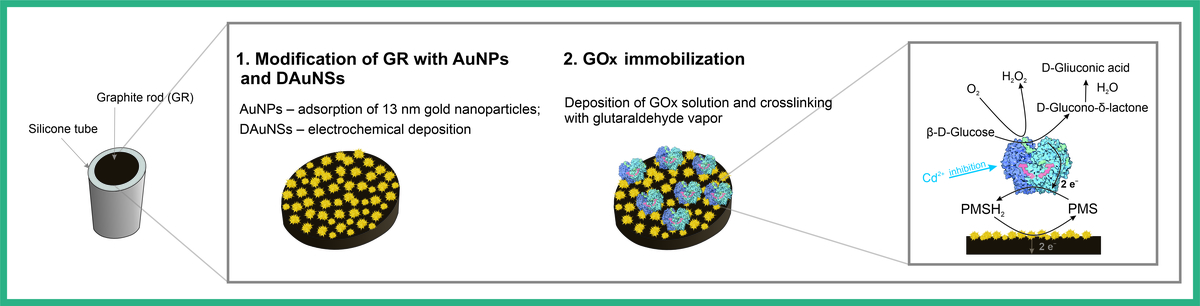
Cadmium is a highly toxic heavy metal that poses significant risks to human health and the environment and, therefore, requires rapid and reliable detection [1,2]. The main goal of his study is to develop and evaluate an electrochemical biosensor capable of detecting Cd\(^{2+}\) ions by inhibiting the glucose oxidase (GOx) activity. The effect of gold nanoparticles (AuNPs) and dendritic nanostructures (DAuNSs) on enzyme inhibition by the Cd\(^{2+}\) ions in the presence of a soluble redox mediator, phenazine methosulfate (PMS), is investigated.
Our approach involves modifying a graphite rod (GR) electrode with DAuNSs via electrochemical deposition and then immobilizing GOx on the electrode surface. We investigated the influence of the applied constant potential and the hydrogen tetrachloroaurate(III) concentration on the formed DAuNSs’ morphology and the glucose biosensor’s analytical signal. The obtained results were compared with glucose biosensors based on electrodes without nanoparticles (GR/GOx) and modified with 13 nm AuNPs and GOx (GR/AuNPs/GOx). We observed that Cd\(^{2+}\) causes a decrease in GOx activity in all cases, which can be registered as a reduced electrochemical signal. However, the highest impact of Cd\(^{2+}\) on the electrochemical signal of the developed biosensor was observed using electrode modified with DAuNSs and GOx (GR/DAuNSs/GOx). These findings suggest that DAuNSs improve glucose biosensors’ performance and offer an efficient approach for monitoring contamination by Cd\(^{2+}\) of the environment and biological samples. These findings can be applied to the sensitive detection of other toxic metal ions.