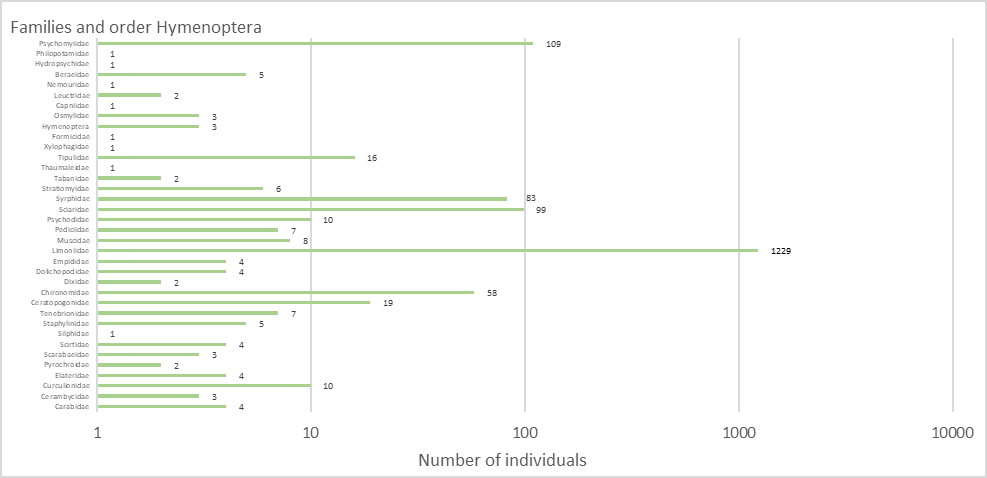
Dead decaying wood in freshwater ecosystems plays a significant role: it maintains balance in food webs and regulates shape, width, and stream flow in rivers and streams. The most important function of dead wood, partially submerged in water, is creating unique habitats for specialized but vulnerable insect species. Those insects that live in dead wood are often called saproxylic insects because they must spend part of their life cycle in decaying dead wood. No research about insect diversity in dead, partially submerged wood in water has been done in Lithuania – this work is the first. The primary purpose of this work is to find out which families, genera, and species choose to live in dead wood, partially submerged in water in Lithuania [1-3]. Organisms were collected from dead, partially submerged wood by hand in May, June, September, and October 2024 using measuring tapes, knife, tweezer, and small jars filled with 70 % alcohol. Collected organisms were identified by their morphological features using a few identification sources with characterization keys. Molecular methods like DNA extraction, polymerase chain reaction (PCR), DNA electrophoresis, and purification of PCR products were used for organisms with questionable identification. Samples were sent for sequencing to BaseClear B.V Leiden, Netherlands. DNA sequence fragments were analyzed using BioEdit and MEGA software. The analyzed sequences were compared with those published in the GenBank and BOLD systems databases. 300 pieces of dead wood from 4 sites and 12 points in Varėna and Trakai districts were examined. 1719 insects were collected (1684 larvae, 22 pupae, 4 puparia, 9 adults). 35 families were identified, of which family Limoniidae was the most abundant (1229) (Fig. 1). Collected insects belonged to 6 orders, of which the most extensive taxonomical diversity was in the order Diptera (16 families). The most diverse families of this order were Chironomidae and Limoniidae (both had 12 genera). The most abundant genus was Lipsothrix Loew, 1873 (1136 individuals) from family Limoniidae. The results show that there is quite a high insect diversity in dead decaying wood, partially submerged in water with the highest diversity in order Diptera.