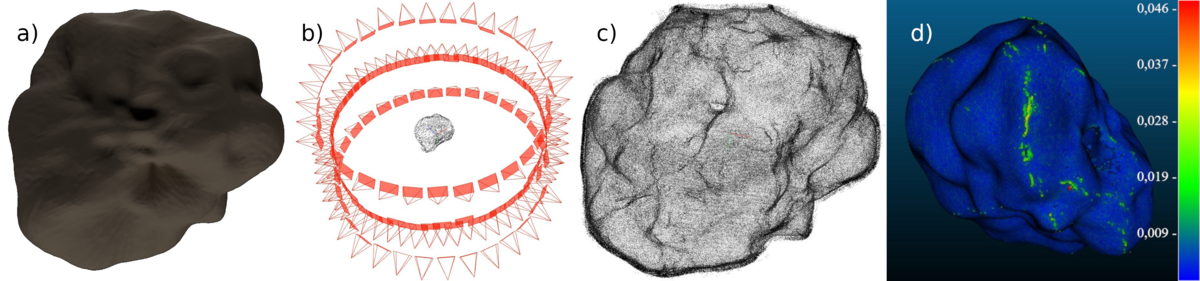
Reconstructing three-dimensional (3D) objects from two-dimensional (2D) images is a crucial technique in computational vision, particularly in astrophysics, where it enables accurate shape modeling of celestial bodies from observational data [1]. This work explores high-fidelity 3D asteroid reconstruction using synthetic image data generated in Blender and processed with COLMAP structure-from-motion and multi-view stereo techniques [2, 3]. The primary objective of this research is to gain a comprehensive understanding of the 3D reconstruction pipeline while assessing the influence of various parameters – such as the number of images, resolution, sampling iterations, and model texture – on the reconstruction quality.
In the study, asteroid models were procedurally created in Blender [4] using a node-based approach with Perlin noise to introduce realistic surface irregularities. Multiple image sets were rendered from different viewpoints under controlled lighting and camera positioning. These images were then processed using COLMAP to reconstruct 3D models, which were subsequently compared against the original Blender model using CloudCompare [5] to assess accuracy via the cloud-to-cloud distance method.
The analysis revealed that surface texture plays a significant role in reconstruction quality. Specifically, a textured surface with high-frequency random noise patterns yielded the most accurate results, while smooth or homogeneous textures led to greater reconstruction errors. The optimal reconstruction was achieved using a dataset of 64 images at full resolution with 128 sampling iterations, resulting in the lowest deviation from the original model. These findings highlight the importance of texture detail and image quality in 3D shape recovery.