
The guided mode resonance (GMR) is an effect introduced by R. Magnusson in thin modulated films which is characterized by narrow-band reflection and transmission properties, high resonance quality factors as well as its applications for spatial filtering in laser systems, polarization filters, and angular dispersion control [1]. Such universal devices are broadly studied, however, only as passive filters that exhibit no optical gain. Structures with optical gain are capable of enchancing the transmitted and reflected radiation via introduced imaginary refractive index, where the imaginary part corresponds to the exponential amplification of guided mode’s amplitude.The concept of enhanced radiation via incorporating gain is illustrated in Fig. 1.
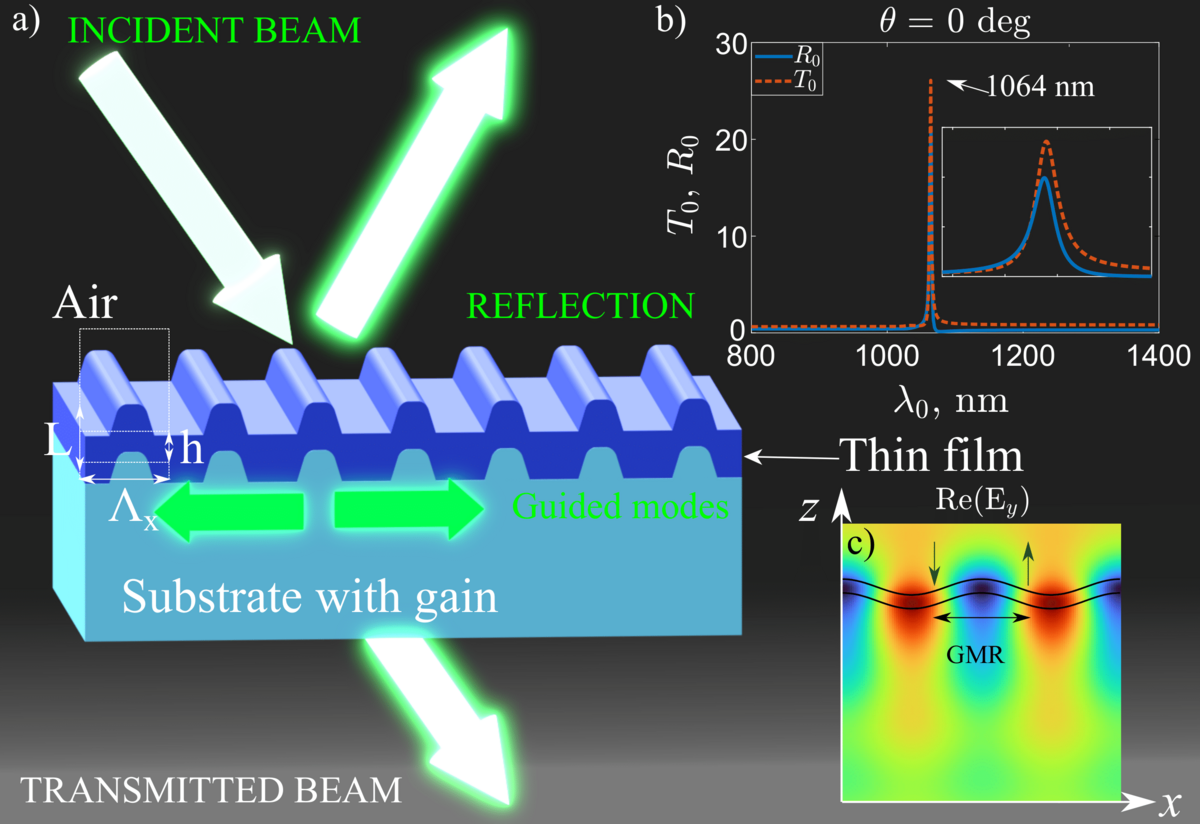
The gain material itself is introduced as a perovskite with imaginary refractive index capable of exponential amplification of diffraction efficiencies [2]. With proper optimization algorithms and numerical tools [3], the device geometry can be tuned to achieve high resonance quality factors and optimal coupling between incident radiation, excited guided modes and the radiation itself, thus maximizing the reflection and transmission coefficient values. Such structures can be used as angle sensitive amplifiers, low-pass amplifiers in laser systems. In this work we apply genetic optimization algorithm with 2D RCWA method to achieve device designs which exhibit enchanced gain via GMR effect. We also expand on the analytical model which we use to quantitavely explain the behavior and characteristics of the achieved results.