
Sources of intense femtosecond laser radiation in the wavelength range of 1.8 – 3 µm are in demand for generating THz and attosecond X-ray pulses [1], particle acceleration and remote sensing, biological imaging, medicine, and material processing by direct excitation of phonon modes. Several approaches to delivering intense ultrashort laser pulses in the wavelength range greater than 2 μm have been explored. The most advanced sources have been shown to be primarily based on optical parametric chirped pulse amplification (OPCPA), operating in the degeneracy range when pumped by a single-picosecond lasers near 1 µm.
We demonstrate a compact and cost-effective mid-IR laser source driven by 1.3 ps pulses from a Yb-rod laser operating at 1030 nm. Broadband supercontinuum (SC) seed pulses in the wavelength range 1050 – 2400 nm obtained in a 130 mm long YAG crystal were amplified in a three-stage collinear OPCPA, and then both the signal and idler pulses were focused into a hydrogen cell to extend the OPCPA coverage beyond 3 µm by the high-order cascade rotational stimulated rotational Raman scattering (SRS). During the experiments, the pressure, cell length, spectral mismatch between the signal and idler pulses, and the chirp induced in the SC pulses were optimized. A modified two-stage four-pass Yb-rod chirped pulse amplifier [2] with a record gain of 10 million was used as the pump source for both SC and BiBO-based OPCPA (Fig. 1 left). Compared to the previous implementation [3] the dispersion of SC seed pulse has been varied using an acousto-optic programmable dispersive filter (AOPDF). 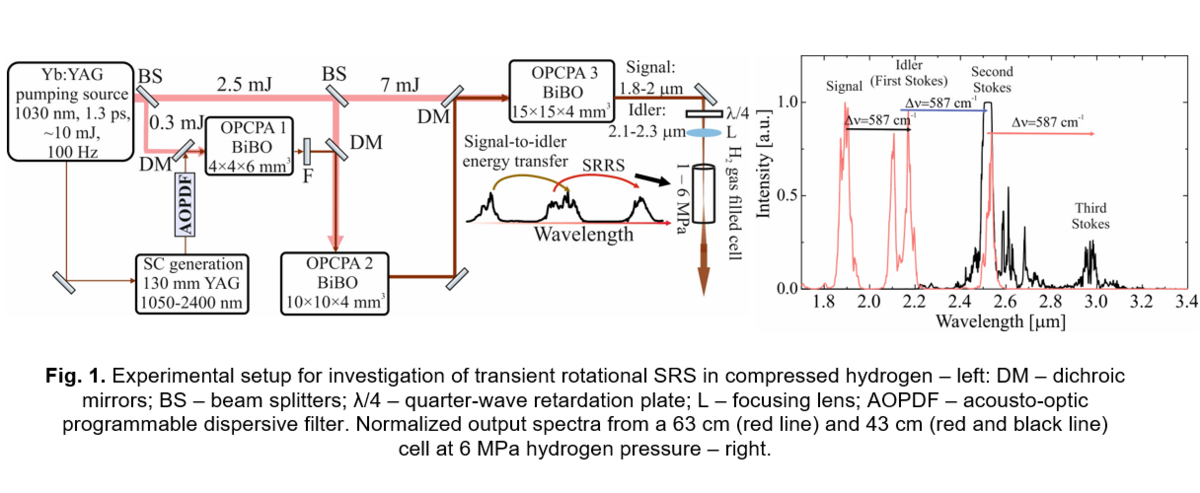
Thus, the generation of high-order Stokes pulses via transient rotational SRS in compressed hydrogen was investigated using sub-picosecond signal and idler pulses in the short-wave infrared spectral range. This new approach to generating intense femtosecond pulses, combining OPCPA with transient rotational SRS, now already provides spectral extension from 2 μm to 3.1 μm.