Laser-based glass welding offers significant advantages over soldering and adhesive bonding by producing durable joints without creep, outgassing, or aging [1]. Femtosecond (fs) pulses achieve high weld strength and quality due to strong non-linear absorption. While widely used in optical contact welding, their application in non-optical contact welding remains limited, with most studies relying on picosecond pulses [2,3]. The major limitation of fs pulses comes from larger beam spot sizes typically used in non-optical contact welding, significantly increasing the Rayleigh range inside the glass. This, in turn, increases non-linear absorption above the focal plane, reducing the energy reaching the weld area and typically causing either insufficient weld formation or thermal stress-induced cracking. The femtosecond laser bursts address this issue by distributing high pulse energy across multiple sub-pulses while maintaining the same energy in the burst. This approach reduces non-linear absorption outside the focal plane, enabling more efficient energy delivery to the welding area.
This study investigated non-optical contact welding of soda-lime glass plates using single-pulses and MHz bursts of an ultrashort pulsed laser. The laser operated at a 1030 nm wavelength, with pulse durations ranging from 176 fs to 10 ps. Weld quality was evaluated using an optical microscope and a surface profiler, while longitudinal tensile tests were used to determine weld strength. Weld strength and quality were compared between different pulse durations.
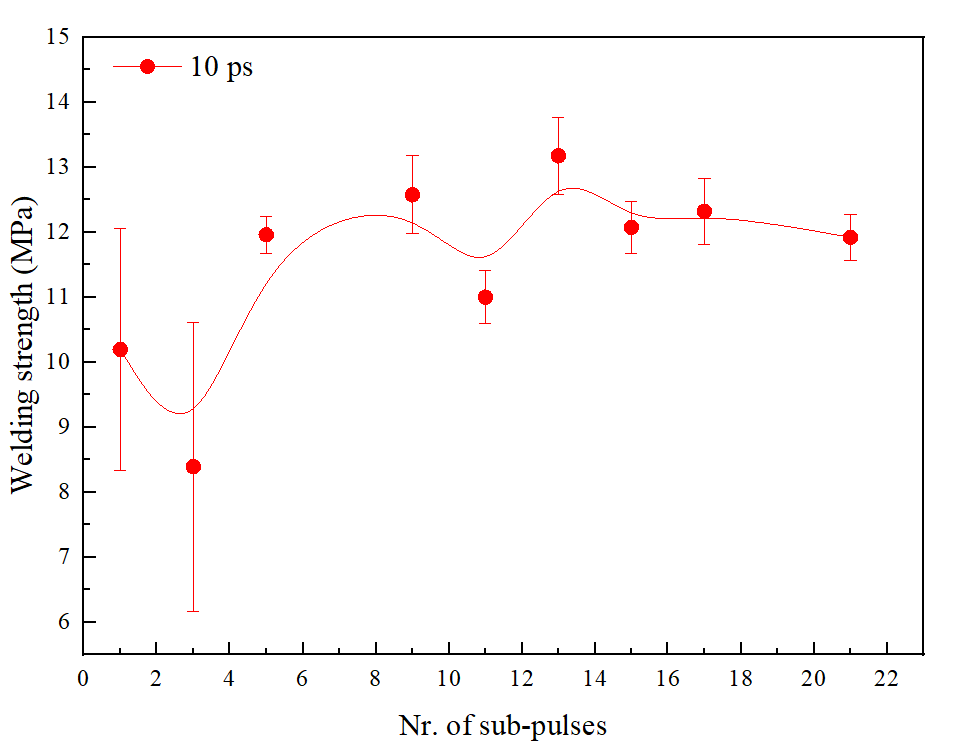
Figure 1 presents the results obtained with 10 ps duration pulses. Increasing the number of sub-pulses within the burst increased the weld strength, reaching a maximum strength at 13 sub-pulses. The highest strength was 30% higher than that of single-pulse welding. Optical microscope analysis revealed that glass fracturing inside the welding area increased with sub-pulse numbers.