$ LASER} Laser-based glass-cutting techniques play a critical role in the precision processing of transparent materials, including various types of glasses. Specifically, an effective material removal mechanism in bottom-up laser cutting provides accurate cuts at high processing rates [1, 2]. However, this results in reduced cut quality and the flexural strength of the cut pieces [3].
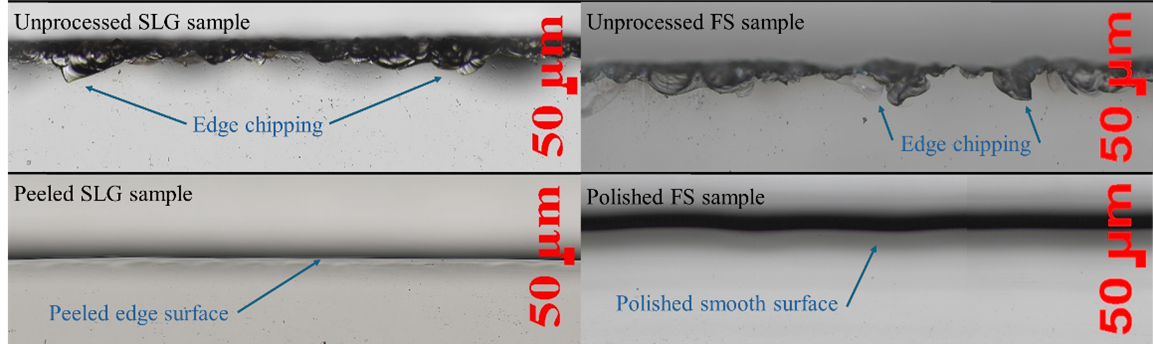
In this work, soda-lime glass (SLG) and fused silica glass (FS) samples were cut using a Carbide 40 (from Light Conversion) femtosecond laser in a BiBurst (GHz burst in MHz burst) regime to utilize the full laser glass cutting potential. A CO laser was used to enhance the cut sidewall quality by peeling [4] or polishing [5] defected glass layer for SLG and FS samples respectively.
After conducting quality enhancement experiments, an experimentally generated map of soda-lime glass peeling showed that successful peeling can be achieved in a narrow laser energy dose window from 11.56 ± 1.37 to 17.92±3.22 J/cm2. Furthermore, due to the removed defective layer, the peeling process increased the cut glass strip strength by up to 2.4 times. Moreover, by remelting the defective layer of fused silica with the laser polishing technique, the strength of the samples increased by up to 2.6 times.
Fig. 1. Optical images of surface chipping of soda-lime glass (SLG) strips (left) and fused silica glass (FS) (right) before and after quality enhancement with a CO2 laser.
[1] M. Mackevičiūtė, J. Dudutis, and P. Gečys, Fast and efficient bottom-up cutting of soda-lime glass using GHz bursts of short laser pulses, Optics and Lasers in Engineering, Vol. 183, 108490, (2024).
[2] P. Gečys, J. Dudutis, G. Račiukaitis, Nanosecond laser processing of soda-lime glass, Journal of Micro/Nanoengineering, Vol.10, pp. 254-258, (2015).
[3] J. Dudutis, L. Zubauskas, E. Daknys, E. Markauskas, R. Gvozdaitė, G. Račiukaitis, and P. Gečys, Quality and flexural strengthof laser-cut glass: classical top-down ablation versus water-assisted and bottom-up machining, Optics Express, Vol. 30(3), pp. 4564-4582, (2022).
[4] T.C. Chiu et al., On the mechanics of laser peeling for ultra-thin glasses, Engineering Fracture Mechanics, Vol. 163, pp. 236-247, (2016).
[5] L. Zubauskas, E. Markauskas, A. Vyšniauskas, V. Stankevič, and P. Gečys, Comparative analysis of microlens array formation in fused silica glass by laser: Femtosecond versus picosecond pulses, Journal of Science: Advanced Materials and Devices, Vol. 9(4), 100804, (2024).