
In recent years, the field of nanotechnology has gained increasing attention due to the successful application of nanostructures in sensor fabrication and the development of new optical devices [1]. Among the successful nanodevices, metal nanostructures, especially those made of noble metals like gold, play a significant role. These materials exhibit unique and strong plasmonic properties that describe the interaction between light and nanostructures. The fabrication of plasmonic nanostructures is often done using electron beam and focused ion beam lithographic methods. However, these methods have limitations in terms of pattern resolution and production cost. Recent advancements in laser-based techniques, such as laser direct writing (LDW) on metal surfaces, emerge as an alternative, offering cost-effectiveness and the ability to control structure parameters directly. The study focuses on the formation of microbumps using LDW, taking advantage of gold’s elastic and yield strength properties. Despite the advantages, there is a challenge in achieving a strong optical response for hybridized plasmonic modes [2]. The study discusses methods to enhance the response, such as reducing the period and increasing the array size. However, limitations arise, and finding the right balance between these parameters is crucial for optimizing the optical response in plasmonic arrays during measurements. 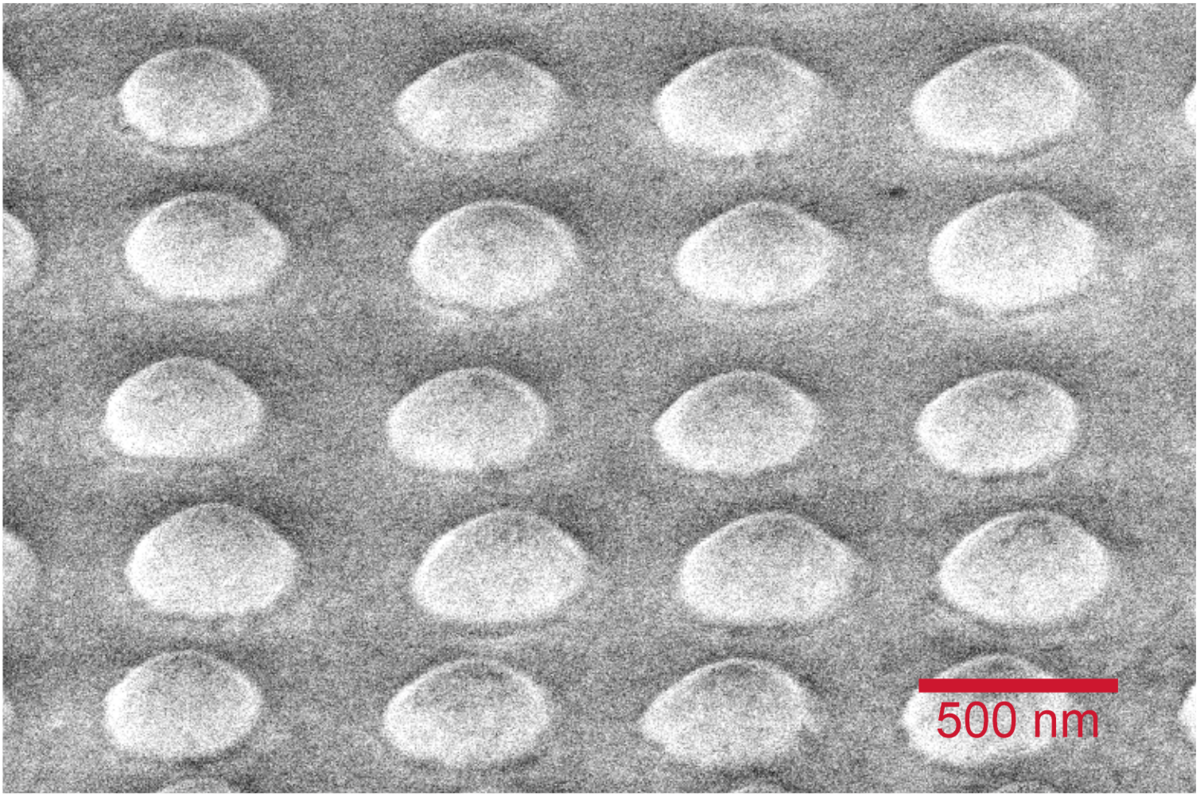
EXPLORING THE IMPACT OF MICROBUMP ARRAYDIMENSIONS ON HYBRID LATTICE PLASMON RESONANCE QUALITY
Rodrigas Liudvinavičius1, Evaldas Stankevičius1
1 Center for Physical Sciences and Technology, Laser Technology Department
[1] K. Yang, et al., Metallic Plasmonic Array Structures: Principles, Fabrications, Properties, and Applications. Adv. Mater. 33(50), pp. 2007988 (2021).
[2] E. Stankevičius, et al., Direct Laser Writing for the Formation of Large-Scale Gold Microbumps Arrays Generating Hybrid Lattice Plasmon Polaritons in Vis–NIR Range, Adv. Opt. Mater. 9, 2100027 (2021).
[3] R. Liudvinavicius, et al., Titanium adhesion layer influence on the formation of hybrid lattice plasmon structures via laser-direct writing, Optics & Laser Technology, Volume 175, 2024.