
According to WHO (World Health Organization) various types of cancer is the second leading cause of death globally. Despite the fact that cancer has no universal cure, it has many targets for possible treatment. In 2023 City of Hope National Medical Center published preclinical research on a targeted chemotherapy using novel small molecule - AOH1996 that appears to suppress tumor growth without causing adverse effects. Our group of scientists developed new synthesis pathway for obtaining N-(2-((2-(3-methoxyphenoxy)phenyl)amino)-2-oxoethyl)-1-naphthamide (AOH-1996)[1] in sub kilogram quantities. New method is superior to previously published in scientific literature because of easily accessible materials and classic techniques are used which allows to significantly reduce production cost while maintaining product quality. In addition, our method does not use chromatographic purification, which further reduces production costs. Synthesis starts from mono methylation of resorcinol with dimethyl sulfate in anisole as a solvent. Obtained 3-methoxyphenol is converted to substituted diphenyl ether by Ullmann reaction with 2-chloronitrobenzene. Nitro derivative is reduced with hydrazine hydrate and Raney nickel as a catalyst. Further, reaction with chloroacetyl chloride and sodium azide followed by reduction with hydrogen gas and palladium on carbon catalyst gives glycine derivative. Finally, reaction with alpha naphthoic acid chloroanhydride gives desired AOH-1996. Moreover, we have synthesized series of compounds similar to AOH-1996 in the expectation that they will also behave as proliferating cell nuclear antigen inhibitors. Synthesized series includes: N substituted glycine derivatives, triazoles formed from intermediate azide and various terminal acetylenes, compounds with other than naphthoyl substituents, attached strained heterocycles such as aziridine and azetidine, nitrogen mustards, etc. To conclude, our group has developed new, efficient and chromatography free synthesis pathway for AOH-1996 and created series of structurally similar compounds for near future studies on cancer cell lines. 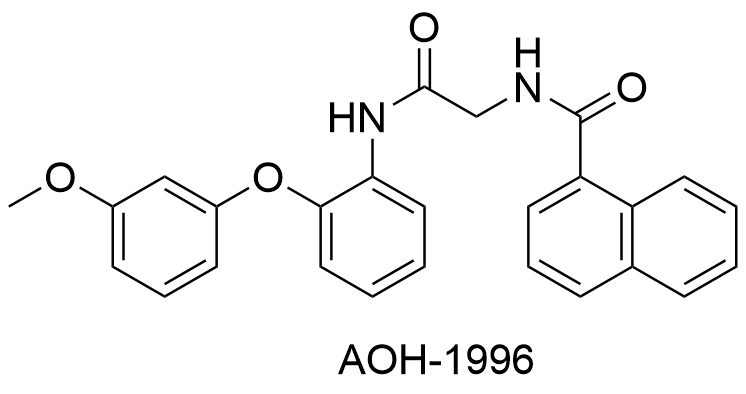
SYNTHESIS OF POTENTIAL PROLIFERATING CELL NUCLEAR ANTIGEN INHIBITORS
Simona Jonušienė1, Mantas Jonušis2, Denis Sokol1
1 Institute of Chemistry, Faculty of Chemistry and Geosciences, Vilnius University
2 Laboratory of Bioorganic Compounds, Institute of Biochemistry, Vilnius University Life Sciences Centre
Fig. 1. Chemical structure of AOH-1996
[1] L. Gu, M. Li, C. M. Li, P. Haratipour, R. Lingeman, J. Jossart, M. Gutova, L. Flores, C. Hyde, N. Kenjić, et al., Cell Chem. Biol. 2023, 30, 1235-1247.e6.