In recent decades, significant progress has been made in the development of ultrashort laser systems with high average power. These laser systems, which operate at high repetition rates (around tens MHz) while maintaining substantial average power, have enabled new applications. These applications span from fundamental scientific research, including spectroscopy, high harmonic generation, and nonlinear microscopy, to precise material processing in manufacturing [1]. As a result, amplification stages are essential for these laser systems. For this purpose, a unique fiber chirped pulse amplification (FCPA) system based on ytterbium-doped large mode area photonic crystal fiber rod amplifier has been developed at the Laser Research Centre of Vilnius University, generating 114 fs pulses with a repetition rate of 76 MHz and an output power of 71 W [2, 3]. Most applications require a tunable wavelength laser source, and therefore a parametric amplifier with supercontinuum (SC) seed will be designed for this laser system. Although continuum generation is already a widely studied phenomenon in most bulk crystals and fibers [4], there are almost no continua demonstrated with such a combination of pump conditions.
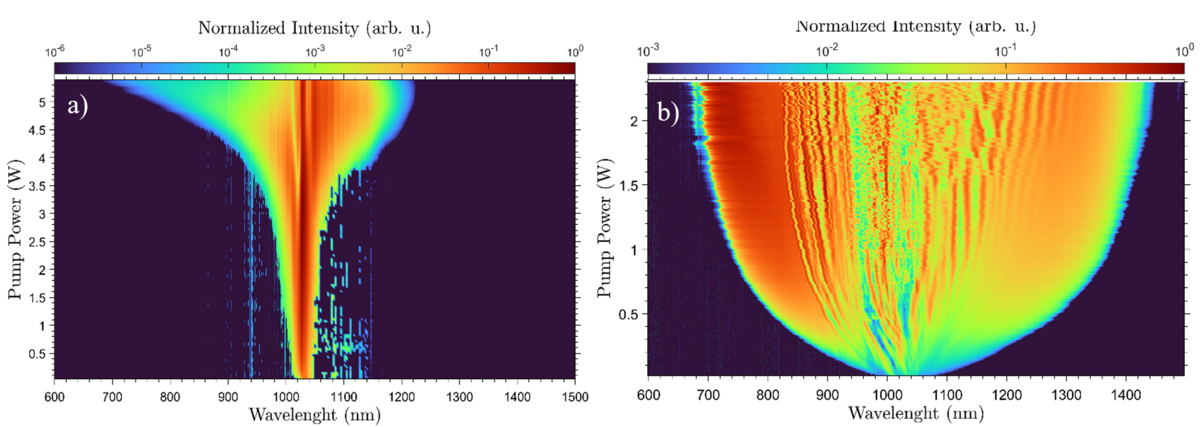
The aim of this study was to investigate and compare supercontinuum generated in 10 mm long KGW crystal and in a 2 m long all-normal dispersion photonic crystal fiber (ANDi-PCF). The SC generated in both cases showed similar spectrum broadening and temporal coherence. The recorded maximum SC spectrum covers wavelengths in the 680 nm – 1220 nm range (evaluated at the 10−6 intensity level) in KGW crystal and 670 – 1450 nm range (evaluated at the 10−3 intensity level) in ANDi-PCF case (Fig. 1). The SC generated in the KGW crystal demonstrated better temporal stability and simplicity of the setup and therefore has more potential for application in parametric amplification.