Over the recent years, organic-inorganic hybrid perovskite solar cells (PSCs) have been attracting a massive worldwide attention due to their low cost and facile fabrication. HTM is one of the quintessential components required for the efficient and stable PSC devices. The hunt is now on for new organic semiconductors that are prepared by simple, cost-effective, and green chemistry without sacrificing the efficiency [1].
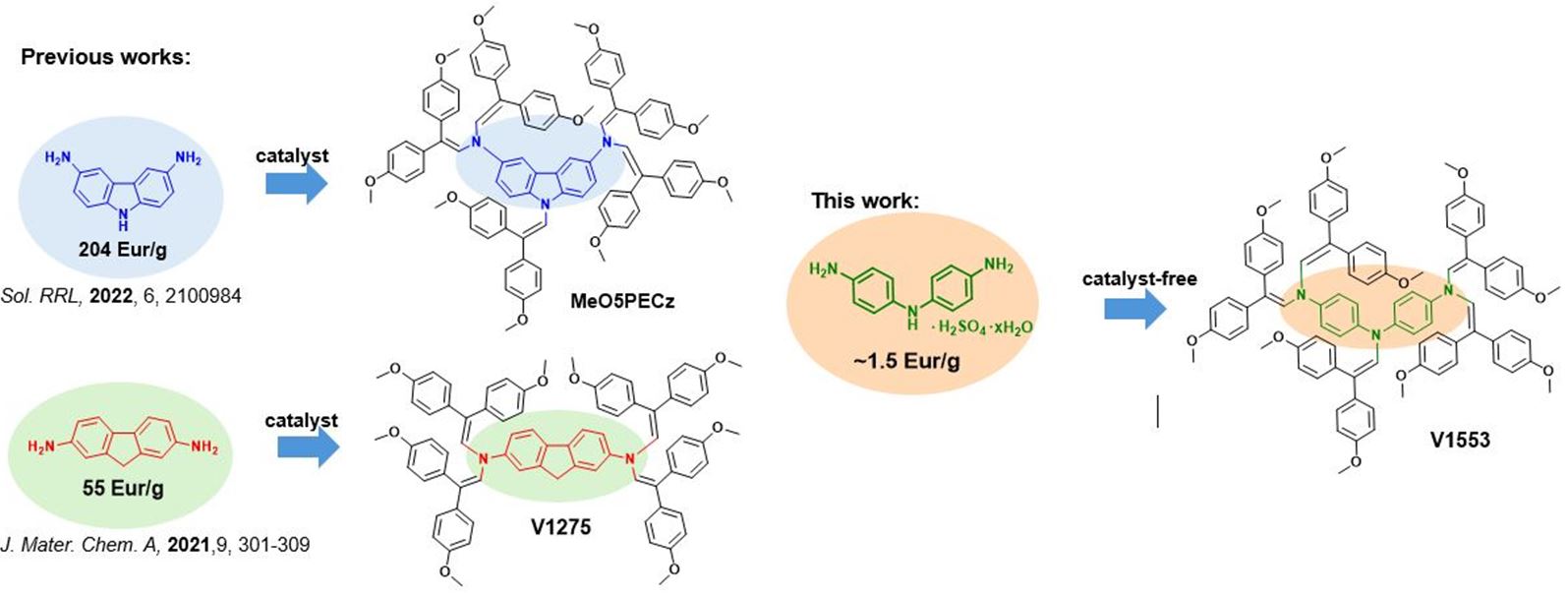
Recently, our research group has focused on tuning the structure by decreasing the number of synthetic steps, thus reducing the synthetic complexity, cost of materials and the environmental impact. This includes reports based on carbazole and fluorene enamines prepared by a facile condensation reaction. In this sense, condensation chemistry is an excellent perspective moving away from palladium-catalyzed reactions since water is the only byproduct and expensive catalysts are not required. Commercially available 3,6-diaminocarbazole (204 Eur/g[2]) and 2,7-diaminofluorene (55 Eur/g[3]) materials were used as starting materials as shown in Figure 1. Those enamines have been successfully applied in PSCs with and without additives, showing excellent efficiency and long-term stability.[4-5] In this work, we have further explored the potential of enamine HTM family employing 4,4’-diaminodiphenylamine as the central core shown in Figure 1. Two diphenylamine-based HTMs were designed and synthesized from extremely low-cost commercially available 4,4’-diaminodiphenyl amine sulfate hydrate (1.5 Eur/g[6]) condensing with corresponding aldehydes without the use of addition of a catalyst. Their optical, thermal, and electrophysical properties were thoroughly investigated. HTMs V1553 and V1565 were amorphous, thermally stable and showed high hole-drift mobility. The PSC based on the semiconductor V1553 reached the highest power conversion efficiency of almost 23%, which is higher than that of the Spiro-OMeTAD-based device under identical conditions.