
Active galactic nuclei (AGN) are sources of immense radiation that can profoundly influence the evolution of their host galaxies. AGN-driven outflows influence the interstellar medium and regulate star formation. To better understand the mechanisms driving these outflows, it is important to comprehend how parameters of the host galaxy, such as star formation rate (SFR), stellar mass (\(M_\star\)) and AGN luminosity (\(L_\text{AGN}\)), relate to key characteristics of galactic outflows, including mass transfer rate, velocity, energy and momentum rates across different cosmic epochs.
In this study, we analyze data from the high resolution, cosmological, hydrodynamical IllustrisTNG50 simulation [1], which is run with the moving-mesh code arepo, and select AGN-driven outflows using criteria such as gas velocities and AGN luminosity. We compare these estimated outflow and galactic parameters with observational data [2] and the semi-analytical magnofit model [3], which is used to generate large-scale outflows, to assess consistency between theoretical predictions and simulated results. Our analysis shows a strong connection between outflow velocity and galaxy stellar mass, which agrees with observational findings. Figure 1 indicates that massive galaxies exhibit more energetic outflows, which can be explained by the relationship between a galaxy’s stellar mass and its black hole. It is also known that more massive galaxies typically have higher star formation rates.
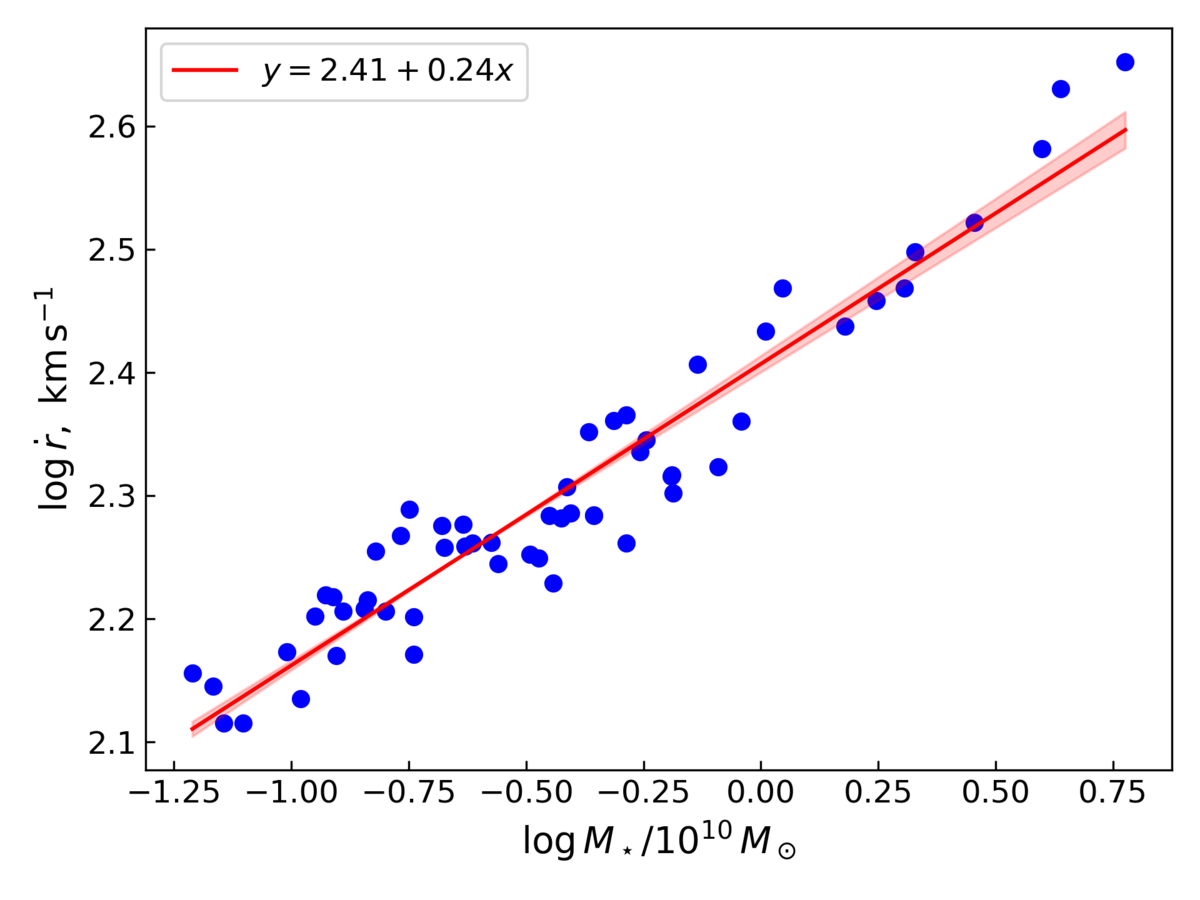
In our study, we find that \(M_\star\), SFR and \(L_\text{AGN}\) are closely related to the outflow velocity, so we describe the overall dependence by a single polynomial equation:
\[\label{eq: r_dot_combined} \log \left( \frac{\dot{r}}{\mathrm{km \, s^{-1}}} \right) = 0,72 \log \left( 895,91 \frac{\mathrm{SFR}}{M_\odot \, \mathrm{yr}^{-1}} + 170,52 \frac{L_{\mathrm{AGN}}}{10^{43} \, \mathrm{erg \, s^{-1}}} \right) - 0,40 \log \left( \frac{M_\star}{10^{10} M_\odot} \right)\]
Our results show reasonable agreement with observational data, particulary in the relation between outflow velocity and galaxy stellar mass. However, some discrepancies remain, suggesting that additional physical processes may need to be considered in numerical cosmological simulations to produce realistic galactic outflows.