
Fiberglass is widely used in the production of different parts to achieve the lightness of the structures without losing strength [1]. In order to create a part with complex geometry, the problem arises that it is necessary to produce larger workpieces, which must be subsequently processed by milling or using other technologies. In this work, a new technology is proposed to avoid further processing of the parts. The idea of the technology is to cut the fiberglass fabric to the required dimensions before curing and then, after precise positioning, cure it with ultraviolet (UV) resin. This process is repeated until the geometry of the required dimensions is obtained.
In this investigation, the fabrication of the composite and the analysis of its mechanical properties were included. Fiberglass and UV resin were used to create the composite. The UV resin was the same as that used for stereolithography (SLA) 3D printers. The fiberglass was cut according to the sample geometry of the ISO 527 standard ’dog bone’. Each layer was covered with UV resin and a new layer of fiberglass was added. The total height of the composite was 3 mm and there were 14 layers of fiberglass inside. The composite was cured with UV light.
Tensile results showed that the addition of UV resin to the fiberglass fabric increased the strength of the sample by 5.7 times. It is worth highlighting that the increase in strength was in one direction, so this should be taken into account when designing products. The tested composite was further analysed with a scanning electron microscope (SEM). After the analysis, it was determined that the UV resin was evenly distributed throughout the composite and filled the air gaps.
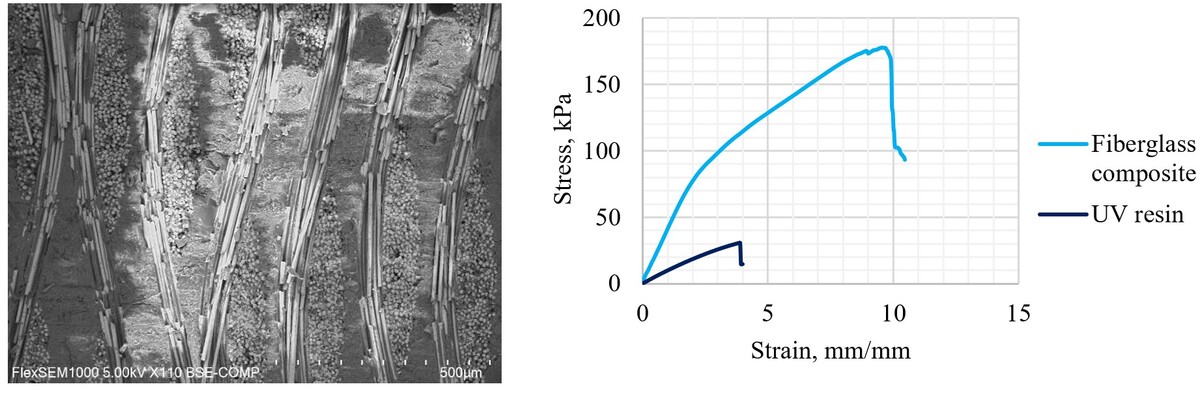
The results of the study led to the conclusion that the technology for producing complex geometry parts using fiberglass composite provides an opportunity to increase the strength of parts. The data obtained will be used in further development of production technology.