
Nanostructures can have quite amazing linear and especially nonlinear optical properties. Metallic nanoparticles, for instance, can localize visible light on a scale of a few nanometers only in the form of surface plasmon excitations [1]. Fabricating polymeric nanostructures on metal surface could induce such surface plasmon resonance (SPR) which has been intensively exploited for a variety of innovative bioapplications, ranging from biosensing, bioimaging, controlled drug/gene delivery, to photothermal cancer therapy, etc. [2]. The geometry of periodic structures strongly influences the wavelength at witch plasmon resonance occurs, so it is very important to conveniently control geometrical parameters of these structures. In this work, it is implemented by interference lithography, which is a efficient, cost-effective, and maskless optical lithography technique for realizing large area periodic patterning at a subwavelength scale resolution [3].
The aim of this research is to investigate the influence of laser pulse peak intensity on periodic polymer nanostructures geometrical properties.
Figure 1 shows two atomic force microscope (AFM) profiles of fabricated nanostructure arrays using different laser pulse peak intensities: a) $18.1 \mathrm{GW/cm^2}$ and b) $0.91 \mathrm{GW/cm^2}$. In figure 1 c) and d), surface profiles of encircled structures are shown. As we see, laser pulse peak intensity strongly influences the shape of fabricated structures: c) $18.1 \mathrm{GW/cm^2}$ irradiation intensity forms structures with $\sim 8 \mathrm{nm}$ depth pit at the center, whereas $\sim 20$ times lower intensity ($0.91 \mathrm{GW/cm^2}$) forms spherical surface structure (Fig. 1c) which is the shape of plano-convex lens. The height of this fabrication is $\sim 120 \mathrm{nm}$, diameter $\sim 510 \mathrm{nm}$, and the radius of curvature, measured by circle function approximation (dotted curve), is $\sim 350 \mathrm{nm}$.
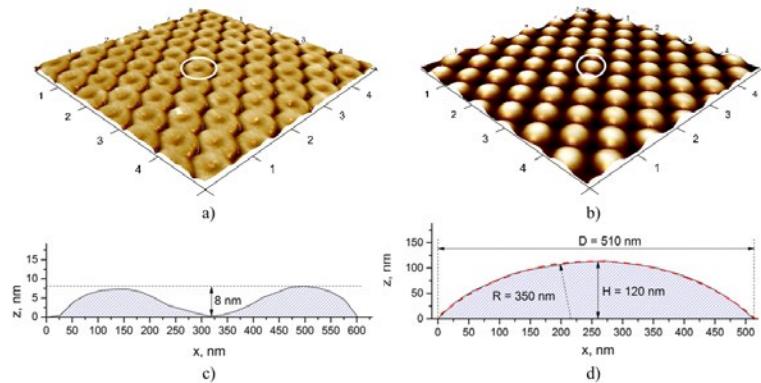
In conclusion, it was demonstrated that using interference lithography technique, laser pulse peak intensity strongly influences geometrical properties of periodic polymer nanostructures. Spherical surface nanostructures are expected to function as nanolenses [4] for focusing infrared and longer wavelength waves, beyond Abbe's diffraction limit. Further investigation is being carried out to test plasmonic effects of these nanostructures fabricated on thin metal layer.