
The Bismuth ferrite, BiFeO3, (BFO) is one of few materials exhibiting ferroelectric (FE) and antiferromagnetic (AFM) ordering above room temperature [1]. BiFeO3 has high temperatures of ferroelectric-paraelectric (TC ≈ 1100 K) and antiferromagnetic-paramagnetic (TN ≈ 643 K) transitions. It is also a multiferroic material, in which electric and magnetic ordering can coexist in a single phase, because of that, it and its derivatives have attracted a lot of attention, particularly Dy-substituted bismuth ferrite.
This work presents broadband dielectric spectroscopy results of dysprosium bismuth ferrite ceramic, BixDy1-xFeO3 (x=0.1, 0.15, 0.2). Dielectric measurements were performed as a function of both temperature and frequency in the temperature range 25 K – 1000 K and in the frequency range 20 Hz – 1 M Hz. The BixDy1-xFeO3 ceramic were prepared by a two-stage solid-state reaction method using the oxides Bi2O3, Dy2O3 and Fe2O3 [2].
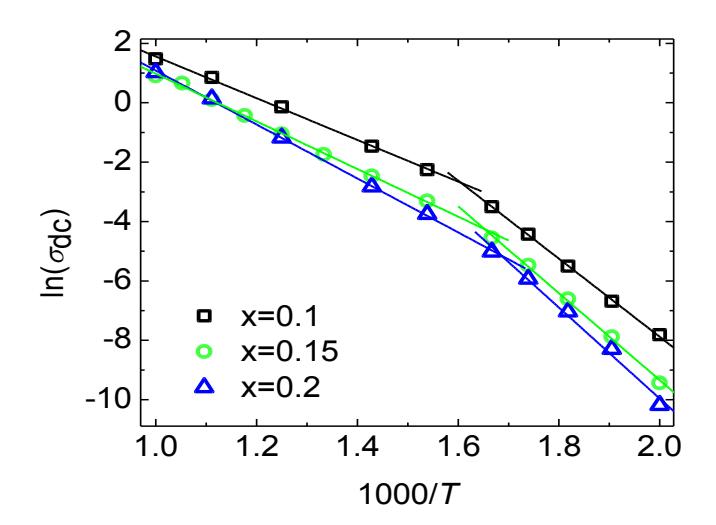
The electrical conductivity was calculated from frequency dependence of the resistance. At higher temperatures (above 400 K) in all investigated ceramics the huge electrical conductivity values was observed (Fig. 1). In all ceramics the temperature of DC electrical conductivity has some change in the slope close to T=590 K, therefore DC electrical conductivity was fitted with the Arrhenius law separately below and above this temperature. The conductivity activation energy increases with the concentration of dysprosium.