Star formation process plays an important role in determining the dynamics and chemical evolution of the galactic disks. Physical mechanisms for triggering star formation and evolution of star forming regions have long been subjects of research in astrophysics, however, the overall picture of the star formation process still remains obscure. Observations of the Milky Way and other spiral or irregular galaxies show that shell-like structures are abundant in the interstellar medium [1]. Actually, they are giant cavities of hot ionised gas created by strong stellar feedback from OB associations. Their sizes are from 100 pc to as large as 1 kpc, being the largest structures created by the star formation process. As the shell expands it either disrupts the existing structures of the interstellar gas or accumulates the surrounding matter creating a layer of gas of increased density or an uneven distribution of clumpy gas clouds at the rims of the shell. These accumulations of matter create favorable conditions for induced star formation, as the compression and collisions of the gas clouds occur here more frequently [2].
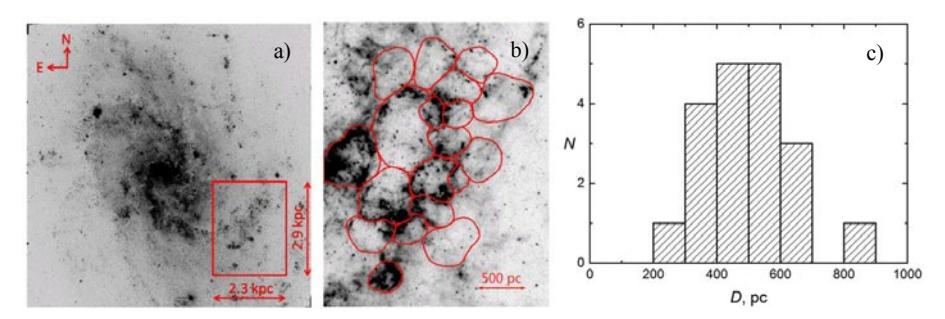
Here we study the large-scale star formation in the disk of M33 galaxy. The supershells of ionised gas are considered to be the main providers of a physical mechanism for triggered star formation. A detailed analysis of a 2.3x2.9 kpc2 field, covering a large star forming complex in the Southern arm of the galaxy, is presented. In total 19 supershells were identified by using data of multi-wavelength observations. These structures range in size from ~200 to ~900 pc and mean size is of ~500 pc (see Fig. 1, panel c). Ages of the supershells were estimated using resolved multi-band stellar photometry data of the M33 galaxy derived from the Suprime-Cam observations with the 8 m Subaru telescope and stellar isochrones. The average expansion velocity of the supershells of ~4 km s-1 was derived. An uneven distribution of gas and dust is observed at the rims of the supershells with some secondary star formation being evident. The latter process is the most efficient within the fronts of "colliding" supershells, suggesting that collisions of dense gas clouds play an important role in the process of induced star formation.