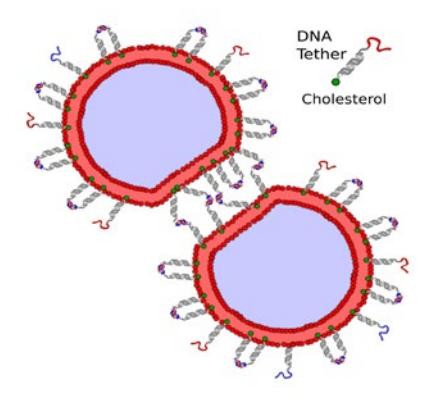
The presentation will discuss phase portraits and properties of infinite networks of DNA-coated vesicles.
Giant unilamellar vesicles (GUVs) are artificial lipid bilayers, of spherival shape. Similiar basic structure governes cell membranes and membranes of many cell organelles.
Individual vesicles have been a subject of research for a long time, as drug carriers (due to their biocompatibility) and as bacteria detectors.
A relatively new line of research is examining the behavior of networks of vesicles. Vesicles' surfaces are coated with single strand DNA (attached to the surface by, for example, cholesterol), which causes an attractive interaction between vesicles coated with complementary DNA strands. A theory regarding the behavior of two adhering vesicles has already been designed, predicting the equilibrium contact angle's dependence on temperature and number of DNA strands [1]. Physically, this is a specific and experimentally accessible realization of a system of soft spheres, connected with entropic springs.
The presentation describes efforts to create a theory describing the behavior of infinite networks of liposomes in various two- and three- dimensional geometries, taking into account elastic energy of membrane deformation, entropic and energetic contributions from confinement of the DNA during interactions, to predict under what circumstances percolation occurs in such systems., and what geometries will be preferred in self- assembly under natural conditions. Understanding the behavior of such systems could lead to novel strategies of drug delivery and production of precious biocompatible materials.