
Diamond like carbon (DLC) films have unique properties such as extremely high hardness, very low friction coefficient, negative electron affinity and optical transparency in the visible and infrared range [1]. Metal doped DLC films possess interesting optical properties due to surface plasmon resonance (SPR) and are promising materials for developing the element base of laser physics, opto- and micro-electronics devices. The SPR feature depends on the size, shape as well as concentration of nanoparticles embedded in DLC host matrix [2]. It is known that Ag nanoparticles can enhanced the Raman scattering signal and the enhancement factor depends on the size and shape of nanoparticles, interparticle distance and their arrangement [3]. The research was aimed on further elucidation of the role of silver nanoparticles in enhancing Raman spectra of DLC as well on influence of nanoparticles on the growth mode of nanocomposites.
In the present research, two types of films were formed: DLC based silver nanocomposites (DLC:Ag) and DLC:SiOx films with different thickness on 20 nm thickness Ag layer (as coated and annealed). DLC:Ag films were synthesized employing unbalanced reactive magnetron sputtering of silver target with Ar ions in acetylene atmosphere. By changing the gas ratio (C2H2/Ar: 10-30%) and bias voltage, films with Ag concentration from 2.8 at.% to 14.8 at.% were deposited. DLC:SiOx films of 11-190 nm thickness were deposited employing closed drift ion beam source. As a precursor hexamethyldisiloxane with hydrogen carrier gas was used.
The structure of the films was determined employing Raman scattering spectrometer InVia (Renishaw), 532 nm wavelength laser. Surface of the films was analyzed with SEM Quanta 200 FEG (FEI) and AFM Nanowizard 3 (JPK) working in AC mode. Ultrafast processes were performed employing transient absorption spectrometer HARPIA (Light Conversion).
Such kind of experiments enabled us to differentiate between the role of nanoparticles in production of sp3 bonded carbon and sp2 clusters as well to study role of silver in surface enhanced Raman spectroscopy measurements (Fig. 1).
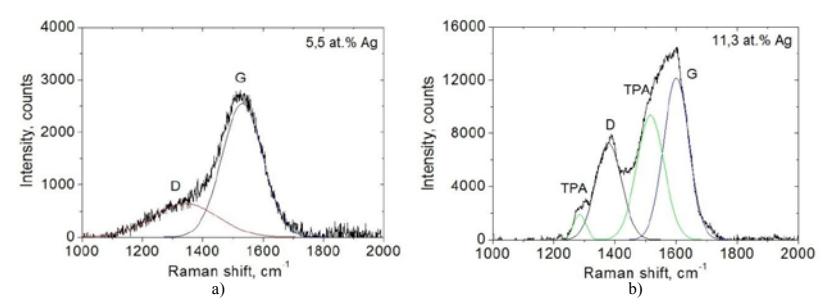
Due to incorporation of Ag nanoparticles in DLC matrix, these nanocomposites show plasmonic response in visible wavelength range. Increase of Ag concentration gives more pronounced SPR peak. Raman scattering spectroscopy results show that DLC:Ag nanocomposite films with larger Ag concentration (> 7 at.%) could be used as plasmonic substrates. Ag layer induces biggest enhancement for DLC:SiOx films of 190 nm thickness. The annealing of Ag layer resulted in the highest enhancement for 22 nm thickness DLC:SiOx film. Particles area analysis of the DLC:Ag SEM micrographs showed that the silver interparticle distance have a significant impact on Raman enhancement. Transient absorption spectra dynamics revealed the existence of two transient absorption relaxation components: negative and positive. Negative transient absorption signal decays during ~1 ps, while positive signal can have two relaxation components which decay ~1 and ~100 ps. Evidently, positive transient absorption signal can show two relaxation processes: fast because of electron-photon interaction and slower phonon-phonon relaxation processes.