
Tethered bilayer lipid membranes (tBLMs) are widely used as biological models for studies of protein-membrane interactions and development of biosensors [1]. tBLMs consists of two layers: the innermost is composed of self-assembled monolayer (SAM) which is covalently attached to metal surface and functions as anchoring site of the membrane. Functionality of tBLM is highly sensitive to conformation and structure of a SAM [2]. SAM is composed of long chain thiol derivative containing 1-mercapto(ethylene oxide)6 moiety and two hydrocaron (myristoyl) chains (WC14) as well as short chain diluent deuterium marked 2-mercaptoethanol (βMEd).
Density functional calculations (DFT) at B3LYP levels of theory using 6-31++g(d,p) basis set have been carried out to investigate the conformational properties of βMEd on Au cluster consisting of 10 atoms and to obtain Raman spectra of both βMEd and WC14 molecules. Surface enhanced Raman spectra (SERS) of both molecules separately and at certain ratio were recorded as well. Experimental data and theoretical calculations are in quite good agreement.
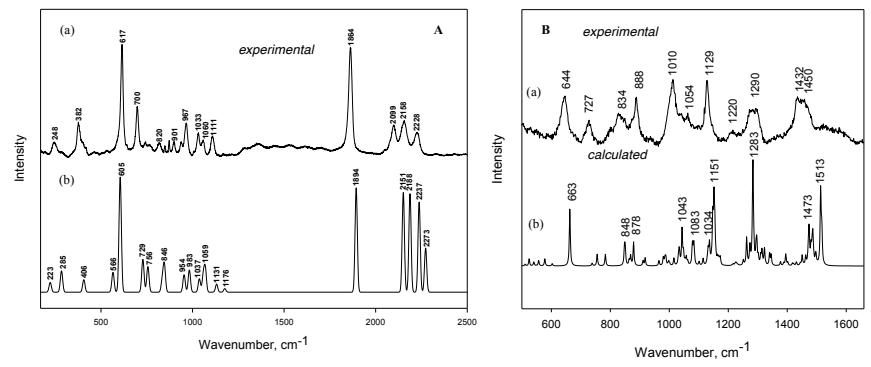
DFT calculations reveal that gauche conformation of C-S bond of βMEd is more favorable over the trans conformation. Similar results were obtained from the experimental Raman spectra (Fig. 1A). The intense band at 617 cm-1 belongs to (C-S)G gauche stretching vibration (in the calculated spectra this band appears at 605 cm-1). (C-S)T trans band is near 700 cm-1 in experimental Raman spectra and have 2.6 times lower intensity in comparison with gauche band. It should be noted, that trans band in calculated spectra is not shown. The detailed assignments of the Raman bands were performed from the data of calculated and experimental spectra. In particular, the strong band near 1129 cm-1 observed in experimental spectra was assigned to all-trans in phase stretching vibration of hydrocarbon (C-C) bonds.