
It is possible to modify the orientation isotropy and centrosymmetry of chromophores made from organic polymers thus creating optical anisotropy, second and third degree optical nonlinearity.
This allows us to use polymers with chromophores in variety of applications in photonics, signal measuring technologies, creating of large density optical or holographic storage devises, functional surfaces, optical frequency converters, modulators or switches in optical devices. [1] [2]
One of the most important and actively researched photochemical reaction is trans→cis photoisomerization. It is observed in molecules that have double bonds, for example: C=C, N=N, and C=N. Optical poling is a new method which allows us to create second order nonlinearity $\chi(2)$ in thin sheets of polymer. [3]
This work studied the parameters of polycarbonate induced with different chromophores and the influence different structures of the polymer has on the dynamics of optical poling. To achieve this poling kinetics of polymers with different structures were measured. Conclusions were drawn from linking the difference in poling kinetics to the difference in the structure of the polymer and by comparing them together.
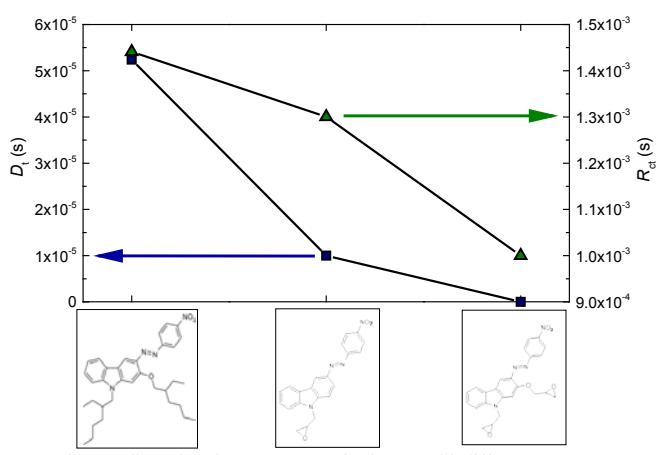
Successfully achieved writing of second order nonlinearity and confirmed that the decay is governed by 2 processes: isomerization of cis-trans (fast decay) and orientational diffusion of trans isomers that are not activated. The results show that adding more anchor structures to the polymer has a tendency to decrease the orientiational diffusion of chromosomes or eliminate it at all as seen in Fig 1.