
Bulk rhenium diselenide is supposed to be indirect band gap semiconductor belonging to the family of transition-metal dichalcogenides (TMDs) [1]. TMD are exciting class of materials due to layered structure which allow to obtain individual layer using e.g. micromechanical cleavage technique. Most of them are indirect bandgap semiconductors in bulk and direct in monolayer.
Rhenium diselenide (ReSe2) is one of the least well-known members of the layered TMD family. In contrast to most of TMDs rhenium diselenide crystallize in a structure with low symmetry (it is triclinic and has a bulk space group $P\bar{1}$). Re atoms in each layer are displaced from the centre of octahedral coordination units and form zigzag chain along the b-axis. The surface of ReSe2 is corrugated on the lateral length scale of unit cell [1]. Lattice distortion leads to the anisotropy of optical and electrical properties in van der Waals plane.
In our measurements we focus on the optical properties of pure ReSe2 single crystals. They were grown directly from the composite elements (Re: 99.99% pure; Se: 99.999%) by the vapor transport method using I2 as transport agent. Transitions of studied material were measured using polarization-dependent photoluminescence spectroscopy in the temperature range of 16-70 K. The observed spectra reveal anisotropic physical properties – observed transitions are polarization-dependent (Fig. 1).
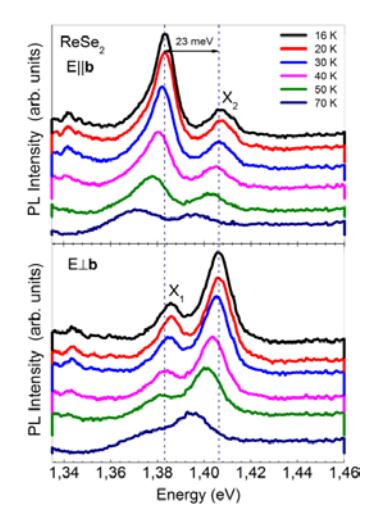
In this work we compare a photoluminescence spectra of bulk rhenium diselenide and very similar to that – rhenium disulphide. Our results confirmed a strong, opposite polarization dependence of observed excitons: the X1 is not allowed for light polarized perpendicular to b axis, whereas the X2 is not allowed for light polarized along the b-axis. This situation is very similar to the case of ReS2. Furthermore we present ways in which ReSe2 may extend the potential of the TMD materials.