Ultracold atomic gases are systems exhibiting various condensed matter phenomena. The ultracold atoms are neutral, so under usual circumstance they do not exhibit important magnetic phenomena, like the quantum Hall effect. Possible ways to create artificial magnetic field for ultracold atoms include rotation of an atomic cloud, laser-assisted tunnelling, shaking of optical lattices [1]. Yet it is difficult to reach considerable magnetic fluxes required for achieving the fractional Hall effect.
Here we theoretically analyse another way of creating a non-staggered magnetic flux for ultra-cold atoms by using a periodic sequence of short laser pulses providing a multi-frequency perturbation. In particular, we consider a possibility to create a square flux lattice for ultra-cold atom characterized by two internal states. The energies of the two internal states have opposite gradients in one spatial direction. Hamiltonian of such system reads,
$$H_0 = \frac{\mathbf{p}^2}{2m}I + bx\sigma_z,\tag{1}$$where b is coefficient of linear dependence of the spatial gradient and σz is the z-th Pauli matrix. The driving consists of periodic in time pulses that couple the internal states and propagate in a direction perpendicular to the energy gradient. Such pulses can be created using mult-frequency radiation:
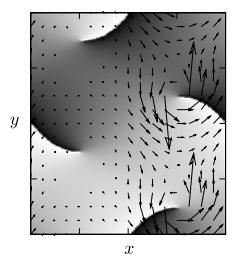
$$V(t) = \hbar\Omega |1\rangle \langle 2| \left( e^{-iky} \sum_{n} e^{-i2n\gamma t} + e^{iky} \sum_{n} e^{-i(2n+1)\gamma t} \right) + \text{H.c.}\tag{2}$$Here Ω is the coupling strength in frequency units, γ is the comb frequency and k is the wave-number. The time-depent perturbation effectively creates a square optical lattice, described by the periodic coupling Veff = σ · B, where B is a real three dimensional vector field and σ is a vector of Pauli matrices. We show that this effective optical lattice produces a non-staggered magnetic flux [2], described by a geometric vector potential, which contains Aharonov-Bohm type singularities (See figure 1). Finally we explore topological properties of such a lattice.