
The two-dimensional Kuramoto-Sivashinsky equation (KSE) for some field $h(\mathbf{r},t)$ with an additional nonlinear term $\nabla^2(\nabla h)^2$ and a single independent parameter $\alpha$ can be written as:
$$\partial_t h = -\nabla^2 h - \nabla^4 h - \alpha \nabla^2 (\nabla h)^2 + (\nabla h)^2 \tag{1}$$It has KSE as a special case when $\alpha = 0$.
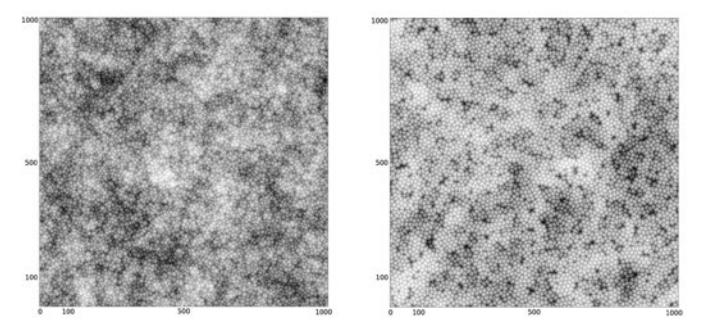
Equation (1), similarly to the simple KSE, serves as a model for evolution of intrinsically unstable interfaces and has been derived as a model for solid amorphous surface growth [1]. It produces disordered cellular patterns at small scales and slow variations of $h(\mathbf{r},t)$ at large scales (see Fig. 1).
One of the most important macroscopic quantities [2] to observe is the surface roughness w(t) (also called the surface width) defined as the rms deviation of $h(\mathbf{r},t)$ from its mean value $\bar{h}(t)$ at time t:
$$w(t) := \sqrt{\left\langle \left( h(\mathbf{r}, t) - \bar{h}(t) \right)^2 \right\rangle_{\mathbf{r}}} \tag{2}$$It has been established that after an initial transient period (crossover time $t_{\times}$), the evolution of the surface according to (1) saturates, i.e., becomes stationary, (at least for parameter values $0 \le \alpha < 5$) and thus the long time average $w_{\text{sat}}$ of w(t) for some $t_0 \gg t_{\times}$ can be defined as:
$$w_{\text{sat}} = \lim_{T \to \infty} \left\langle w(t) \right\rangle_{t \in [t_0, t_0 + T)} \tag{3}$$Since the numerical simulations are performed on the finite size systems (with periodic boundary conditions), the system size L becomes an additional parameter of the problem.
Numerical simulations of (1) exhibit dependence of $w_{\text{sat}}$ (3) on the system size L. The results indicate power-law dependence of the spatial 'power-spectral density' S(k) on the wave number k for small wave numbers (large distances):
$$S(k) \approx C k^{-\gamma} \text{ for } k < k_c \tag{4}$$This leads to a conclusion that, although cellular surface structures of definite scale dominate in the range of short distances and are independent of the system size (as long as it is at least several times larger than the average size of a single cell of the cellular pattern), there is also a scale-free long-range structuring present, as [3] suggests for KSE.
The dependence of the spectral power $\gamma$ on the parameter $\alpha$ shows that the nonlinear term $\nabla^2(\nabla h)^2$ not only influences the evolution on small scales (the size and shape of cells in the cellular patterns), but also changes the large scale behavior in a definite way: it reduces the influence of small wave number modes, making the roughness w finite even for $L \to \infty$.