EVALUATION USING FINITE ELEMENT METHOD OF MICRONIC SCALED POLYIMIDE SCAFFOLDS FABRICATED WITH FEMTOSECOND LASER
Linas Šimatonis1, Aušra Gadeikytė1, Tomas Tamulevičius1, 2, Orestas Ulčinas1, Brigita Abakevičienė1, 2, Sigitas Tamulevičius1, 2
1 Institute of Materials Science, Kaunas University of Technology, K. Baršausko St. 59, LT-51923, Kaunas, Lithuania
2 Department of Physics, Kaunas University of Technology, Studentų St. 50, LT-51368, Kaunas, Lithuania
Artificial membranes and scaffolds can be applied for drug delivery, artificial organs, tissue engineering and other medical applications [1]. Laser structured polymer films can serve as three dimensional scaffolds for different cells that can be used for targeted soft tissue replacement and engineering of soft tissues, such as cardiac muscle, blood, nerve, cartilage and retina [2].
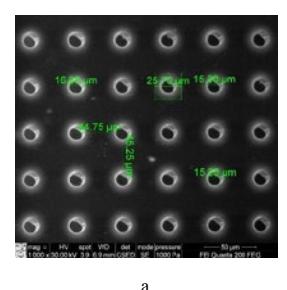
In the current work arrays of holes in 26.7 μm thickness polyimide film (KaptonHN, DuPont) were microstructured employing Yb:KGW femtosecond laser Pharos (Light Conversion) and micromachining system FemtoLab (Altechna R&D). Biocompatible polymer film was laser patterned arrays of 30 to 45 μm spaced 14-16 μm diameter hole arrays. Quality of the structure was evaluated with scanning electron (see Fig. 1) and optical microscopes, while mechanical properties of the membrane were measured experimentally with a custom build micro tensile device [3] and compared with simulated ones obtained employing finite element method (FEM, Comsol Multiphysics). Samples were stretched to strain reaching 5.5%. Fitting the experimental stress-strain curves and varying mechanical properties in the simulation software (Young modulus 0.75GPa, Initial yield stress 0.69MPa and kinematic tangent modulus 231MPa) von Misses stress were obtained.
Fig. 1. Hole arrays in polyimide film for scaffold applications fabricated employing femtosecond laser. (a) SEM micrograph (hole diameter 15.00-15.25μm, gap between two holes 45 μm). (b) 2D distribution of von Mises stress simulated with FEM.
Acknowledgments: This work was supported by European Social Funds Agency Grant No. VP1-3.1-ŠMM-10-V-02-029
[1] D. F. Stamatialis, Bernke J. Papenburg, M. Gironésa, S. Saiful, S.N.M. Bettahalli, S. Schmitmeierb, M. Wessling, Medical applications of membranes: Drug delivery, artificial organs and tissue engineering. - J. Membr. Sci., 308, 2008, 1-34p
[2] R. Rai, M. Tallawi, A. Grigore, A.R. Boccaccini, Synthesis, properties and biomedical applications of poly(glycerol sebacate) (PGS): A review. - Prog. Polym. Sci., 37, 2012, 1051-1078 p.
[3] http://www.sciencedirect.com/science/article/pii/S0143816603000800 Last time checked 2015 02 06