
Layered superconductors, e.g., strongly anisotropic high-Tc crystals Bi2Sr2CaCu2O8+δ or artificial compounds Nb/Al - AlOx/Nb, represent materials with the periodic structure, in which thin superconducting layers (of thickness about 2-3 Å) are coupled through the thicker dielectric layers (of thickness about 15 Å) via the intrinsic Josephson effect. The interest to such structures from the fundamental science perspective is mainly related to the specific type of solid state plasma that is formed inside of them, the so-called Josephson plasma. The anisotropy of the layered superconductors supports propagation of the specific excitations, called Josephson plasma waves (see, e.g., [1] and references therein). These waves belong to terahertz frequency range, which is very important for various applications and is promising for the applied science. The possibility to control wave transmittance by means of external DC magnetic field has special interest, since the magnetic field represents a flexible tool to control the transparency of layered superconductors.
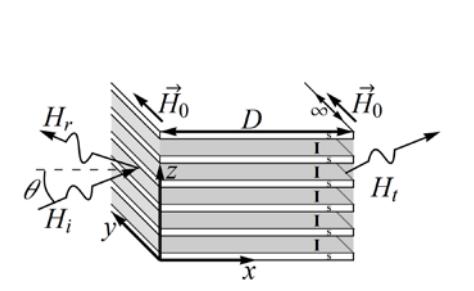
In this work, we study theoretically the transmission of transverse-magnetic (TM) waves through the finite-thickness sample of layered superconductor in the presence of the external DC magnetic field (see geometry in Fig. 1). We show that, due to nonlinear relation between electromagnetic field and the current inside of the layered superconductor, the transmittance of electromagnetic wave depends on the value of the magnetic field. We obtain the transmission coefficient and study its dependence on the problem parameters, such as the sample thickness, the angle and frequency of the incident wave. Studying all these dependencies we focus our attention on the effect produced by the external DC magnetic field.
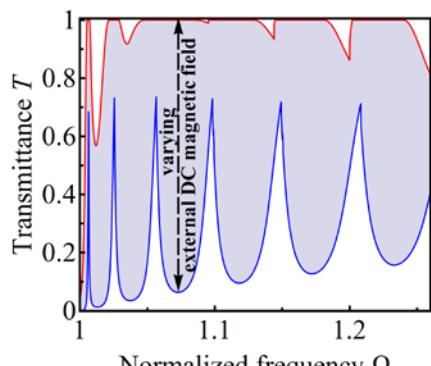
The dependence of the transmittance on the thickness of the sample is periodical. We show, that the DC field effectively narrows the thickness and shifts the maxima of transmittance, but does not change the periodicity. When the effective thickness matches the integer number of the half-wavelengths in the sample, the complete transmission takes place. It turns out that the effect produced by the DC magnetic field depends both quantitatively and qualitatively on the values of the problem parameters. The choice of the incident angle and frequency defines the behavior of the transmittance with the change of external DC field. We show that, for frequencies not very close to Josephson plasma frequency, the complete transmission of the sample is certainly observed for definite incident angle and DC field. In addition, for any incident angle, the variation of external DC field results in significant variation of transmittance from nearly zero to one (see Fig. 2). Thus, with the proper choice of parameters, the external DC magnetic field can be a useful tool to adjust the transmittance or vary it in a wide range.