
Tin dioxide (SnO2) is a n-type wide-band gap ($E_g = 3.6$ eV) semiconductor. SnO2 porous nanostructures due to high surface to volume ratio have received considerable attention in many applications including lithium-ion batteries, photocatalysts, solar cells, medical diagnostics and chemical gas sensors [1-3].
Here we report a template assisted sol-gel synthesis route to prepare polycrystalline SnO2 nanostructures [4, 5]. Polycarbonate membranes used as templates were removed by calcination at 550-1300 °C. Sintering temperature, morphological features, phase composition and crystal structure of the SnO2 nanostructures were studied by thermogravimetrical analyses (TGAs), scanning electron microscopy (FE-SEM) (shown in Fig. 1), transmission electron microscopy (TEM) and X-ray diffraction (XRD) techniques.
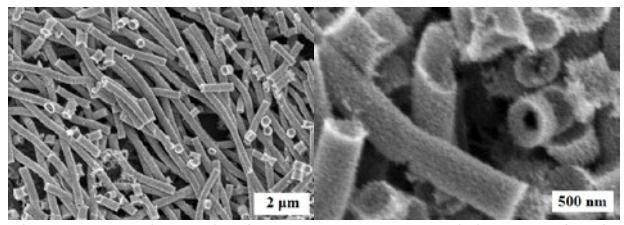
In summary, nanostructures having narrow-size distribution and well-defined structural features were produced. Various processing conditions were examined and the initial cation concentration, organic additives, solution pH and processing temperature were found to affect the morphology and structural properties of final product. Smaller diameter and hollow nanotubes were produced from solutions of lower concentration.