
An interplay of interaction and statistical properties for quantum 1D gases is seen in a low-lying part of their excitation spectrum particularly well if the latter is discrete in the limit of large number of particles, N. The discreteness is ensured by confining quantum gas with the external potential. Ratio $\omega/\omega_c$ of the frequency of the lowest compressional (breathing) mode, $\omega$, and the dipole mode, $\omega_z$, was investigated for a Lieb-Liniger gas confined by a parabolic potential in experiments [1,2]. It was observed that $\omega/\omega_c$ goes through two crossovers: from 2 to $\sqrt{3}$, and then from $\sqrt{3}$ to 2 as the system goes from non-interacting to weakly interacting, and then from weakly interacting to strongly interacting regime [1]. The latter crossover has been described theoretically, by the approach based on the local density approximation (LDA). A description of the former crossover has not been done so far.
We report analytic and numerical results for ratio $\omega/\omega_z$ obtained within the repulsive Lieb-Liniger gas model for the parameters accessed in experiments [1,2]. We describe a crossover from non-interacting to weakly interacting gas analytically by making use of Hartree approximation for $N \gg 1$. More specifically, $\omega$ is obtained by calculating the response of the cloud size to a change of trap frequency $\omega_z$ :
$$\omega^2 = -2 \frac{\langle Q \rangle}{\partial \langle Q \rangle / \partial \omega_z^2}\tag{1}$$where $Q = \sum_{i=1}^{N} (z_i - Z_{\rm cm})^2$, and $Z_{\rm cm} = \sum_{i=1}^{N} z_i/N$ is the center of mass coordinate. Our Hartree solution connects smoothly with the one for weak to strong interaction crossover, obtained with LDA. We complement analytic approaches with extensive diffusion Monte Carlo simulations made for up to 25 particles, thus elaborating effects from finite N (Fig. 1).
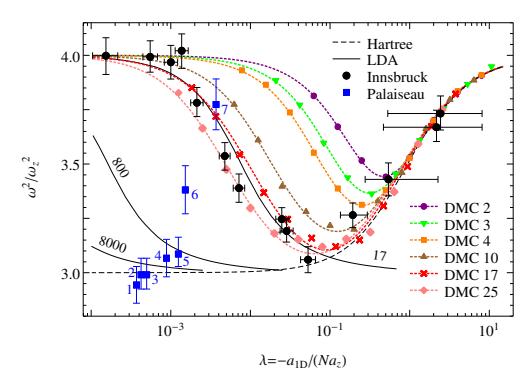
Our zero-temperature results show perfect agreement with data from Innsbruck experiment [1]. On the other hand, we found a mismatch with those data points from Palaiseau group [2] which are away from mean-field prediction $\omega/\omega_z = \sqrt{3}$.