
The array of parallel cylinders is a convenient object while investigating complex structures, which possess properties that can be used in electronics. Structures from periodic cylinders - photonic crystals - are used in optics as elements of objects which control a beam. Photonic crystals of macroscopic elements are convenient because one can easily manipulate them without any special equipment and the requirements for the precision of processing of the surfaces are lower [1]. Periodic dielectric or metallic structures are a subject of continuing interest because of their wide use for practical devices in microwaves and optical waves [2]. The problem of electromagnetic wave scattering by a finite cylinder set is once again interesting due to the possibility of modeling different type structures [3]. These structures should have perspective properties for their application in electronics and be made from materials with high absorption. Also further development should be made for the problems arising in the range of THz waves [4]. Calculating the intensity of diffraction on a screen is important due to the possibility of creating better optical instruments that can produce higher resolution. This can be used in creating improved microscopes. Calculating techniques allow us to solve boundary problems of complex two-dimensional structures made from cylinders [5], [6].
After solving the boundary problem we find magnitudes of cylindrical waves. With a set of field values one can characterize the system with the required accuracy. It isn't convenient because we have to operate with large amounts of data. Here we investigate the intensity of an EM wave diffracting through a finite set of cylinders with 1 and 2 slits of width 2λ, here λ is the wavelength of the incident wave. We study these parameters with different distances between the cylinders, distance from the screen and slit width. By doing calculations with different parameters we try to find qualitative features of the phenomenon.
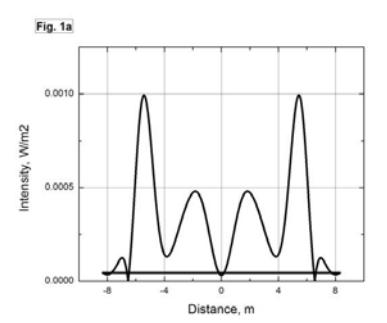
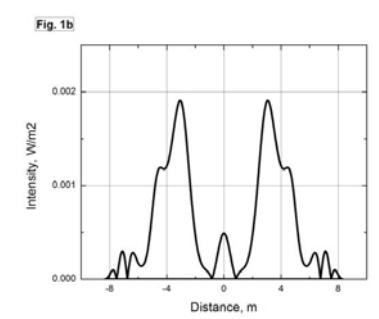
In Fig. 1 we present the dependencies of the intensity of an EM wave observed on a screen placed at different distances from the set of cylinders. There are N=36 metal cylinders placed perpendicular to the propagation of the wave. The cylinders are of radius R=2mm the cylinders are touching each other but not overlapping. The cylinders are perpendicular to the XoY plane and placed parallel to the Y axis. The screen on which we observe the intensity is placed parallel to the Y axis with the given distance from the cylinders. The frequency of the incident wave f=12GHz. As one can see depending on the distance of the screen from the set of cylinders under investigation the place where we observe the maximum of intensity changes (see Fig. 1 a and b).