
Polymorphism is the ability of solid state of matter to create different crystal structures (also amorphous state) depending on the external conditions. Although substances at normal conditions exist mostly in their stable form, it is possible to examine their behaviour by changing, for example, the pressure and temperature.
Using standard Diamond Anvil Cell (DAC) very high pressures can be obtained, even exceeding 15 GPa. The ability of DAC to create tiny homogenous environment for an examined substance results in requiring very small quantities of studied compound. This makes DAC an ideal tool for experiments. However, using DAC decreases the number of reflections that can be measured as a consequence of reducing angular acces to the sample.
In typical DAC (shown in Fig. 1), sample and a chip of ruby are put inside a small hole in a gasket made of alloy of hard metals and compressed by two diamond culets [1]. Diamonds are pushed towards by screws that control the stability of pressure.
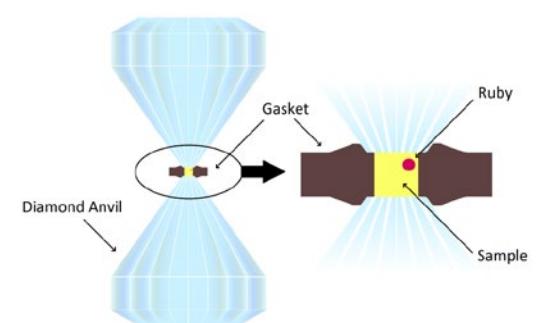
Procedure of preparing DAC involves using a fluorescent pressure sensor, usually a ruby chip. Illuminated by a laser, ruby fluoresces giving two R-line peaks and their shift depends on the pressure inside the cell [2][3].
Two methods can be used while loading DAC. If the initial substance is in the solid state, it is important to fill the hole in the gasket with hydrostatic fluid to ensure that forces propagate isotropically. However, if a sample is a liquid at normal conditions, it is essential to melt the polycrystalline mass that appears after the compression and slowly grow a monocrystal with as few dislocations as possible. Placing the sample between polarizer and analizer gives a great insight into homogeneity of the crystals and allows for notification if any unwanted twinning occurs.
Mostly, anodes in diffractometers are made of molybdenium or copper, which have the wavelength of emission lines Kα 0.71 Å and 1.54 Å, respectively. However, using shorter wavelength enables to spot more reflections in the reciprocal space and closer crystal planes may be measured, according to the Bragg equation, Eq. (1). Silver has the wavelenght of Kα 0.56 Å, which makes this metal significant for constructing the anodes in X-ray tubes to study diffraction of monocrystals inside DAC.
$$n\lambda = 2d_{hkl}\sin\theta\tag{1}$$Aside from analyzing the crystal structure, one of the goals of the high-pressure crystallography is looking for high-pressure polymorphs of low-temperature crystal structures and obtaining single crystals of compounds which are difficult to crystallize at ambient conditions. Substances which I analyze are simple organic compounds, mostly benzene substituted in different positions with methyl, hydroxyl group and halogens. These compounds are liquid at normal conditions, but their melting point is slightly lower than room temperature. Although some chemicals I examine in DAC exhibit clear phase transition, the other form amorphous phase with no long-range order. I will show a few examples of such studies.