
Nowadays one of the most important parameters for the light source is an excellent colour rendition. Ideal light source should render colours with the highest colour fidelity in general case. Illuminated objects with a similar reflectance spectrum should be discriminated and hue distortion must be minimal [1].
The main objective of this investigation was to research human colour discrimination ability under different conditions of the same solid-state lightning source. Farnsworth–Munsell 100 Hue Test [2] (FM test) was chosen. It contains 85 different hue caps of the same saturation which are divided into four colour areas. Test subjects are asked to arrange coloured caps according to their chromatic vision. The number of errors made during the test correlates with a human ability to discriminate colours.
Six participants (3 men and 3 women with average age of 23) took 5 sets of FM tests under two different luminances (0.5 cd/m2 and 10 cd/m2). Each set represents a different level of colour quality: ${\sigma}=0$ – dulling lighting; ${\sigma}=0.15$ – natural (the highest fidelity) lighting; ${\sigma}=0.31$ – preferential lighting; ${\sigma}=0.65$ – slightly saturated; ${\sigma}=1$ – fully saturated. Sets were generated in random order by the tetrachromatic metameric solid-state light source consisted of red, amber, green and blue light-emitting diodes with colour rendering index of 93 at 3000 K natural lighting.
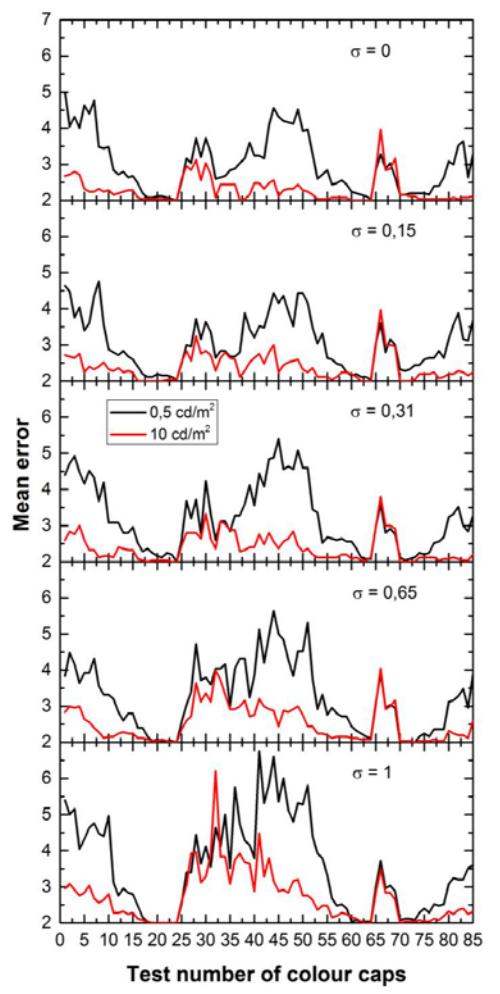
Results of the colour discrimination are showed in Fig. 1. Black line shows mean error for each colour cap at low luminance, red line - for high luminance. Under the 0.5 cd/m2 luminance (mesopic vision) mean error score is considerably higher than under 10 cd/m2 luminance (photopic vision). Colour quality sets reveal that the highest number of errors are when ${\sigma} = 1$ and the lowest at ${\sigma} = 0.15$ and ${\sigma} = 0$. This shows that colour discrimination is the best under natural or slightly dulling lighting. Research revealed that human ability to discriminate colours is the poorest in greenish (caps from 25 to 55) and reddish (caps from 75 to 15) visible spectrum regions. The best discrimination is in the yellowish and purplish regions. Errors repeated in every set from 65 to 70 caps are originated by the incorrect FM test caps reflectance and degradation. Decreased errors at green-blue colours region with increased luminance are conditioned by the eye sensitivity shift from cyan to green colour. Finally, this investigation shows that when metameric light source increases gamut area of illuminated objects, it decreases the ability to discriminate colours.