Cardiovascular diseases are the leading cause of morbidity and mortality in the world. Intervention methods are traditional in the ischemic conditions treatment. However, in spite of the good results obtained, intervention methods have some disadvantages: low efficiency of angioplasty in vessels with intracoronary thrombus and restenosis. One of the most perspective methods of interventional cardiology is the intravascular use of low-frequency high-intensity ultrasound [1]. But it was found that in addition to effective restoration of arterial patency ultrasound exposure has a negative impact on the vascular wall [2]. Therefore it is important to search for optimal parameters of ultrasonic exposure and use of the immersion medium.
Objective of work is to investigate the effectiveness of immersion liquids use with ultrasonic thrombolysis.
Methods: 1) Elmors chemical condensation method was used for immersion liquids creation; 2) Toxic investigation methods were used for bio neutrality tests; 3) Mass degradation method was used for investigations of clot destruction efficiency; 4) Calorimetric and luminescent methods were used for cavitation threshold investigations.
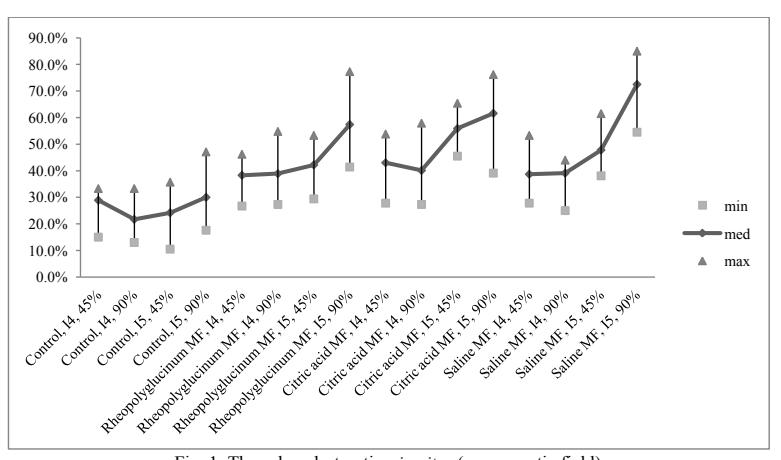
Results: 1) The cavitation threshold in immersion liquids is much lower than the cavitation threshold in blood (8-14 times less), so less energy needed for cavitation. 2) Three different immersion liquids had developed (based on 0,9% NaCl solution, based on dextran, based on an aqueous solution of 10 % citric acid). Immersion liquids showed an extremely high performance of bio neutrality (experiments in vitro on erythrocytes and in vivo on laboratory mice). 3) The experiments of clot mass degradation in vitro showed an increase of degradation using immersion (MF) liquids (relative to the control sample); (without magnetic field) 9.3 - 27.4% for immersion based on dextran; 14.1 - 31.6% for immersion based on 10% citric acid solution (Fig. 1); (with magnetic field) 9.8 - 42.5% for immersion based solution 0,9% NaCl; 9.5 - 47.3% for immersion based on dextran; 12.3 - 45.9% for immersion based on 10% citric acid solution; 6.3 - 44.8% for immersion based on solution 0,9% NaCl. 4) Immersion liquid based on 10% citric acid solution showed the best results in clot destruction.