
Today light - emitting diodes (LED) based smart luminaires offer higher energy efficiency and also have unique properties such as instantaneous and efficient dimming, flux directionality, variable color temperature and selectable saturation/dulling ratio. With such possibilities there is a need of safe, effective, affordable and reliable communication system between luminaires and controlling devices such as smartphones and computers. Wireless communication system was selected because wired solution would require investment in data and electrical wiring infrastructure and would not be as flexible as wireless system.
After investigation, ZigBee communication protocol was selected for further applications. Alternative protocols such as Wi-Fi or Bluetooth were rejected due to too high energy consumption, possible interference with other household devices, lack of reliability or limited possibilities.
ZigBee protocol offered very low power consumption, mesh network topology which ensures high reliability and accessibility, wireless data rate of 250 kbit/s (more than enough for control commands) and secure 128 bit encryption.
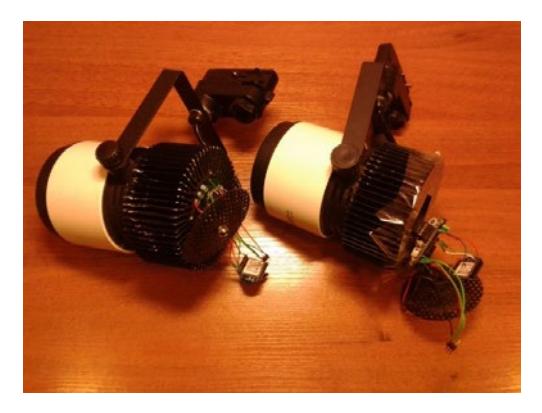
Two smart luminaires with ZigBee modules were assembled for in-use examination. During testing, different configurations of modules were used. Measurements of maximum transmission distance in different environments were performed. Also communication disruptions were simulated to make sure that level of reliability is sufficient.
ZigBee communication protocol meets the requirements for smart lighting applications and was selected for further product development.