
Every day we use mobile internet in smartphones and tablets. Growing need for fast and reliable internet connection requires implementation of 4G LTE network which can offer download speeds up to 300 Mbit/s and upload speeds up to 75 Mbit/s [1]. However, when implementing or expanding LTE networks, providers have to take into account, that LTE (2300-2400 MHz) is spectrally adjacent to MMDS (Microwave Multichannel Distribution Service) system (2200-2300 MHz). MMDS is used for general-purpose broadband networking, but more commonly for transmission of digital television. Since these two systems are near each other, there is a possibility that this proximity can cause interferences between MMDS and LTE systems. Interferences to MMDS are more significant, since this system uses receivers that are designed to work in frequencies overlapping with LTE frequency band, while LTE devices work only in their frequency range [2].
In this work electromagnetic compatibility of MMDS broadcast with LTE system was investigated. Also, frequency separation, needed to receive television transmission properly, was determined. The investigation was carried out using DVB-T (Digital Video Broadcasting – Terrestrial) and DVB-C (Digital Video Broadcasting - Cable) signals in MMDS system. Fixed signal power values were set for MMDS and LTE signals and the minimum frequency separation, when transmission without interferences could still be seen, was found.
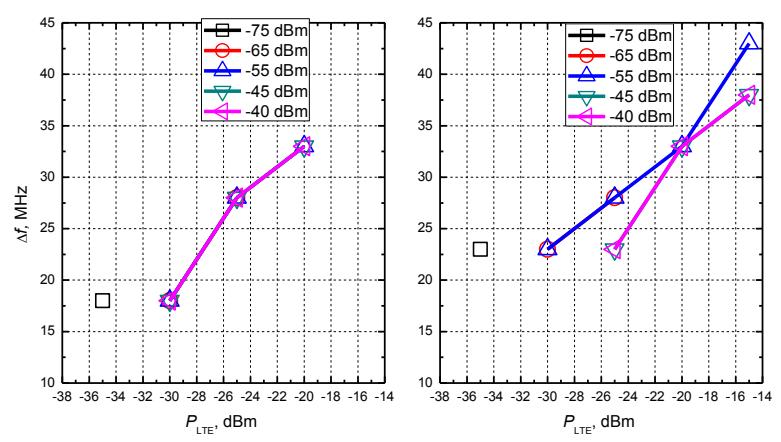
After investigating compatibility, we discovered that MMDS resistance to LTE interference had very little relation to MMDS signal power itself (Fig. 1). The resistance to interference was determined by LTE signal power and frequency separation between these two systems, meaning that LTE signal causes saturation in MMDS receiver. Moreover, after comparing results with DVB-T and DVB-C signals in MMDS system we determined that both DVB standards have very similar level of protection against interferences.