AlGaN-based devices (LEDs, LDs or HEMTs) usually perform at relatively high carrier density (in LDs case exceeding 1019 cm-3), which can induce permanent changes in optical and electrical properties [1]. However, depending on device's application these alterations can be either harmful or desired. In this report, I used optical light induced transient grating (LITG) technique to permanently modify and then examine carrier nonradiative recombination rate and diffusivity in AlGaN within a wide range of Al content.
A set consisting of six 0.3 – 1 μm thick uncoated AlGaN epilayers was grown using migration-enhanced metalorganic chemical vapor deposition (MEMOCVD®) on c-plane sapphire substrates. Al content varied between 16% and 71%. 25 ps duration and 10 Hz repetition pulses of 213 nm wavelength were used both for excitation in optical annealing procedures and LITG measurements. All samples were annealed at the same 2x1020 cm-3 carrier density, taking into account from sample to sample varying absorption coefficient. After annealing for a defined duration, the LITG transients were measured at safe 3x1019 cm-3 carrier density, which didn't induce permanent changes in carrier dynamics. It should be noted that optical surface damage in studied AlGaN layers occurred only at carrier densities an order of magnitude larger than those used in annealing (> 1x1021 cm-3). All optical annealing procedures and LITG measurements were performed at room temperature.
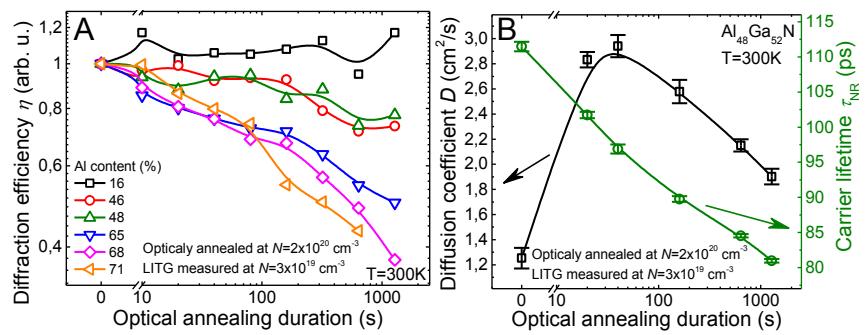
Optical annealing of AlGaN epilayers permanently affected three measured parameters: diffraction efficiency $η$, nonradiative recombination time $τ_{NR}$, and ambipolar diffusion coefficient $D$ of nonequilibrium carriers. Annealing-induced diffraction efficiency drop showed no saturation with increasing annealing duration (within measured 1280 s – 12800 shots), and was most pronounced in Al rich AlGaN layers – two-fold drop in Al71Ga29N vs none in Al16Ga84N layer after 320 s annealing (Fig. A). Nonradiative recombination, carrier temperature and structural disorder (localization strength $σ$) were not solely responsible for annealing effectiveness rising with Al content (not shown).
Nonradiative recombination rate 1/$τ_{NR}$ increased with annealing duration at a constant pace (Fig. B) and accounted for diffraction efficiency diminishing within the annealing span. The 1/$τ_{NR}$ growth was most probably caused by an increased concentration of nonradiative recombination centers (possibly via activation of closed core screw dislocations), increased homogeneouity of their spatial distribution, or an easier access to them through the lowered potential barrier. Diffusion coefficient was a peaked function of annealing duration: (i) the amplification of $D$ by ~2.4 times in the fast initial part could be attributed to an increased mobility of Al and/or Ga atoms, thus enhancing their intermixing, and weakening localization of nonequilibrium carriers; (ii) slow tail-ended part of decreasing diffusion coefficient was possibly caused by the recovering structural disorder.
In conclusion, I report permanent more than two-fold increase of excess carriers' diffusivity under intense laser illumination in AlGaN, revealing particularly attractive application in the possible performance enhancement of high electron mobility transistors (HEMTs).