In the recent years the technologies of organic semiconductors have drawn much scientific attention for their great variety of compounds demonstrating valuable fluorescence and phosphorescence abilities. The industry of the organic optoelectronic devices, such as field transistors, OLED's and solar cells, is based on molecular properties of the organic compounds. A novel research on thermally activated delayed fluorescence mechanism granted a record efficiency of a blue light OLED, which was achieved by varying the positions of the singlet and triplet states. Thus, it is of great interest to understand and, eventually, control the singlet and triplet energy states by supplementing different substitutions of compounds and its surroundings.
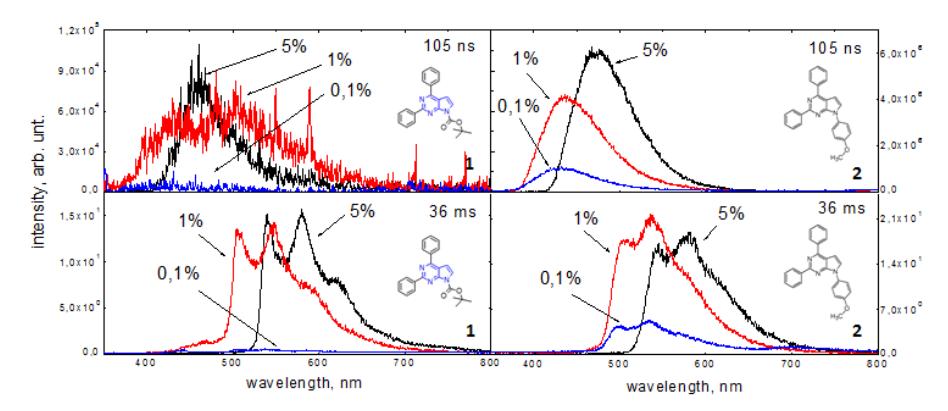
In this work the pyrrolo-pyrimidine derivatives with tert butoxycarbonyl (1) and methoxymehane (2) substitutions were investigated. After a detailed analysis of the emission spectra dynamics in time, three emission channels were pointed out. Initially, the fluorescence is observed, which is thought to be prevailed by the emission of the charge transfer state. Regarding the 1 compound, the emission from singlet state peaks at 390 nm and shifts to 420 nm, lasting for about 100 ns. As for the 2 compound the fluorescence is located at 415 nm and also shifts to 450 nm, while continuing for about 120 ns. Afterwards, the slightly redshifted (due to reabsorption) delayed emission is registered from 120 ns to 440 µs. For both compounds the phosphorescence spectra express vibronic structure lasting several seconds. The maxima of 1 and 2 compounds are positioned at 540 nm with 1% mass ratio of compound to the host matrix and 580 nm with 5% mass ratio. The bathochromic effect of the fluorescence and phosphorescence in the samples with higher concentration is caused by the enhanced interactions between the molecules.
The emission decay time characteristics of the pyrrolo-pyrimidine derivatives with different substitutes at pyrrolo-nitrogen position demonstrated one-exponential molecular fluorescence decay. Meanwhile, the non-linear delayed fluorescence decay time for both compounds implies to the triplet-triplet annihilation (TTA) [1] process. The TTA process is known to be highly dependent on concentration, however, the pyrrolo-pyrimidine derivatives exhibited no such dependency. Moreover, the 1 compound demonstrated more expressed phosphorescence and less rapid TTA rate then the 2 compound. The most efficient emission from triplet states was registered in the samples with 1% mass ratio.
Considering the results achieved, the photoluminescence emission is influenced only by the singlet energy states and polarity of the substitutes. Nonetheless, the surroundings of a compound have a minor effect on the triplet energy states.