
Optical parametric chirped pulse amplification (OPCPA) is an established technique for producing ultrashort, TW-level peak power light pulses for probing light-matter interactions in the strong field regime [1,2]. Most OPCPA systems operating in the visible-NIR range are seeded with pulses from Ti:Sapphire oscillators and pumped by frequency-doubled Nd:YAG laser pulses. Such systems require complex solutions for stabilizing the seed pulse carrier-envelope phase (CEP), ensuring seed and pump pulse synchronization, and improving temporal contrast. We present the conceptual design and preliminary experimental results of an OPCPA setup based on Yb:KGW and Nd:YAG lasers, avoiding most of the issues of Ti:Sapphire-based OPCPA systems.
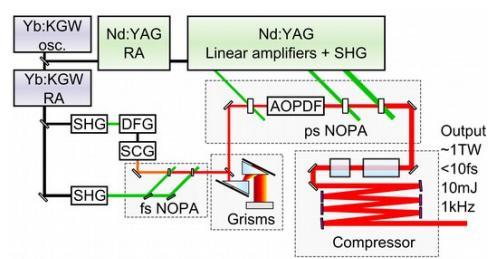
The layout of our proposed OPCPA setup is depicted schematically in fig. 1. Yb:KGW and Nd:YAG regenerative amplifiers are seeded by an Yb:KGW oscillator. Passively CEP-stabilized pulses at 1.3μm are produced in a difference frequency generator (DFG). Difference frequency pulses are focused to a sapphire plate to generate a CEP-stable supercontinuum, which, after pre-amplification in a femtosecond non-collinear optical parametric amplifier (NOPA), is used to seed the OPCPA. The DFG and fs NOPA are both pumped by second harmonic of the Yb:KGW laser. The seed pulses are stretched in a negative dispersion grism stretcher to ~70ps and sent to picosecond amplification stages, pumped by frequency-doubled Nd:YAG laser pulses. The diode-pumped Nd:YAG amplifier system delivers 532nm pulses with up to 50mJ energy at 1kHz repetition rate. Amplified pulses will be compressed using bulk glass and chirped mirrors. An acousto-optic programmable dispersive filter is used to compensate residual high-order dispersion. Upon completion, the system is expected to deliver <10fs, 10mJ pulses with 850nm center wavelength.
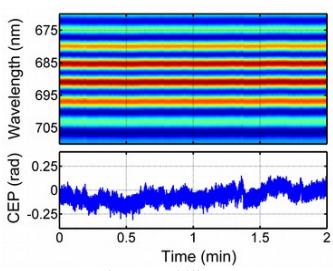
So far, we have developed and characterized the fs NOPA. With 400μJ pump pulses, the fs NOPA delivers pulses with >75μJ energy. The amplified pulse spectrum extends from below 700nm to over 1100nm, theoretically allowing for pulse compression to below 6fs. We have also demonstrated excellent CEP stability of the fs NOPA measured by f-2f interferometry (fig. 2). The short-term CEP noise is measured to be <67mrad during a 2 minute measurement interval. Furthermore, using a simple feedback loop, we have also demonstrated CEP noise <120mrad during periods of over 20 minutes.
Results of pulse amplification in the picosecond stages and pulse compression will be presented in the conference.