
Nuclear magnetic resonance spectroscopy, most commonly known as NMR spectroscopy, can provide detailed information about the structure, dynamics, reaction state, and chemical environment of molecules. Differences between isotropic values of nuclear magnetic shielding tensors, the so-called chemical shifts, are most common observables in the NMR spectroscopy. Room temperature ionic liquids (RTILs) are a class of organic salts that remain liquid at or near room temperature. Recently, RTILs have been attracting a great deal of attention of many researchers, as they have many potential applications in separations, catalysis and electrochemistry. These liquids are regarded as environmentally "green" solvents, because they are nonvolatile, thermally stable and recyclable. Furthermore, through different combinations of cations and anions, there is a tremendous variety of these so-called “designer” solvents. With great versatility of their chemical and physical properties, ionic liquids can be thus tailored and tuned for specific tasks.
The quantum chemical (QM) calculation is a valuable technique to obtain useful information without any experiments. The method has been applied to RTILs to obtain the structures of ion pairs and thermodynamic properties. Unfortunately, QM calculations are very computation-intensive and can be only implemented in very small systems. So, the intrinsic relation between the microstructure and property cannot be revealed in this way. Atomistic simulation, usually known as molecular simulation, is one of the most promising approaches to investigate structural and dynamic properties of molecules and materials. Success of molecular simulation for accurately predicting various properties depends on the quality of inter- and intramolecular potential functions, i. e., force fields.
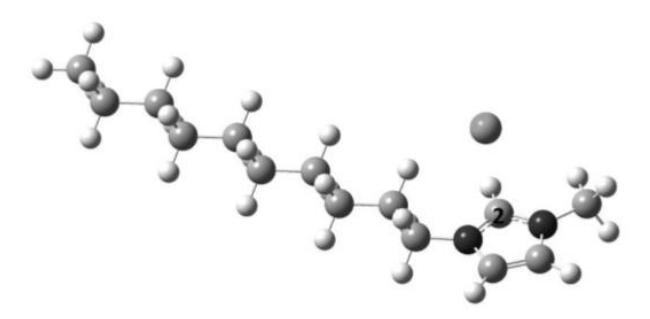
Experimentally, a curious behavior of the 1H NMR spectra of 1-decyl-3- methyl-imidazolium ([DMim]) molecule (Fig. 1) - a popular cationic component of imidazolium based ionic liquids – dissolved in solvents of varying polarity was recorded: the increasing shielding of the proton at the 2nd position of the imidazolium ring was observed with the rising polarity of the solvent [1].
In this work, we have modelled the 1H NMR spectra of [DMim][Cl] ionic pair dissolved in three solvents of different polarity (dichloromethane, acetonitrile and water). We have performed molecular dynamics (MD) simulations for these systems, using AMBER based force field for the ionic pair due to Liu et al. [2]. The standard TIP3P potential was utilized for water, and GAFF force field was used for other two solvents with point charges derived using RESP procedure as implemented in the Antechamber package. GAFF is compatible to the AMBER force field and it has parameters for almost all the organic molecules. GAFF is suitable to study a great amount of molecules. MD simulations were performed in NVT and NPT ensembles. Detailed information concerning local structure was obtained by analyzing relevant radial distribution functions (RDF). Having recorded the trajectories of the systems, we turned to the combined quantum mechanics/molecular mechanics (QM/MM) based calculations of the NMR parameters. Calculations of the proton chemical shifts were performed using both polarizable and non-polarizable potentials for solvents.
Detailed account of the results will be presented at the conference.