
Since the end of the 20th century autonomous driving was experimented on huge computers installed on heavy cars [1], as well as microcontroller [2] and field-programmable gate arrays [3]. This work describes the investigation of implementation of artificial neural networks for autonomous self driven vehicle with embedded Linux system.
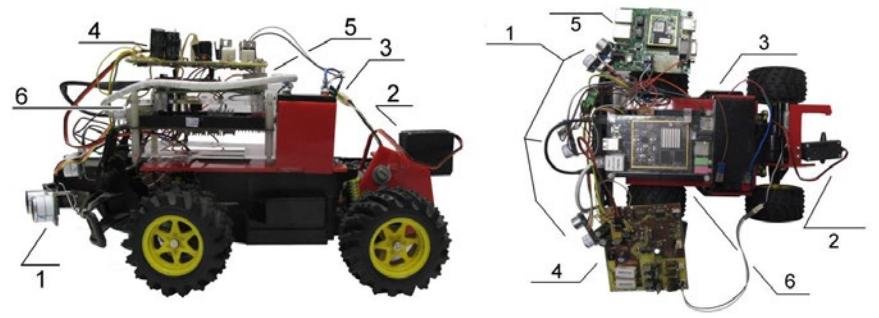
The goal of this work is to investigate the compatibility of feed-forward back-propagation artificial neural network open source library on an embedded Linux system while implementing it for autonomous driving based on supervised learning. The vehicle (see Fig. 1, 2) was constructed using an RC model chassis, sonar distance sensors (1), additional servomotors (2), lead power cell (3), custom power control board (4), and two embedded Linux system boards for data relay and processing – Carambola (5) and Iteaduino Plus A10 (6). Three different neural network architectures were tested for the autonomous driving. The experiments were performed on an improvised track out of domestic objects. All of the construction, assembly and programming were performed in the M2M laboratory in the Faculty of Physics, Vilnius University.
The results yield that the neural network with 3 hidden layers out of 20 neurons in each converges better than the one with a single hidden layer out of 100 neuron architecture. 20 neurons in each hidden cells are enough for both forth and reverse wise motion, whereas only 3 neurons in each hidden layer are enough for only forward motion. The 3 hidden layer network also converges in 7 seconds on the Core 2 processor, whereas on the Allwinner A10 – in a minute. The experiments also showed that thin obstacles are barely noticeable by the vehicle both in front and profile. Reverse movement is possible only when the obstacle course is static, meaning nothing should appear behind the vehicle.
The method used in this probe may be used in flying vehicles and man-machine interfaces [4].