High intensity laser physics scientific group is developing optical parametric chirped pulse amplification (OPCPA) system NAGLIS in Vilnius university, laser research center. In OPCPA, the efficiency of amplification process, the gain bandwidth and the pulse contrast strongly depends on the temporal profile of the pump pulse and the ratio between pump and seed pulse duration. It is known that rectangular (super-Gaussian) spatiotemporal shape pump pulse is optimal for OPCPA system, therefore, it is necessary to be able to manage and control these pump pulse characteristics [1, 2].
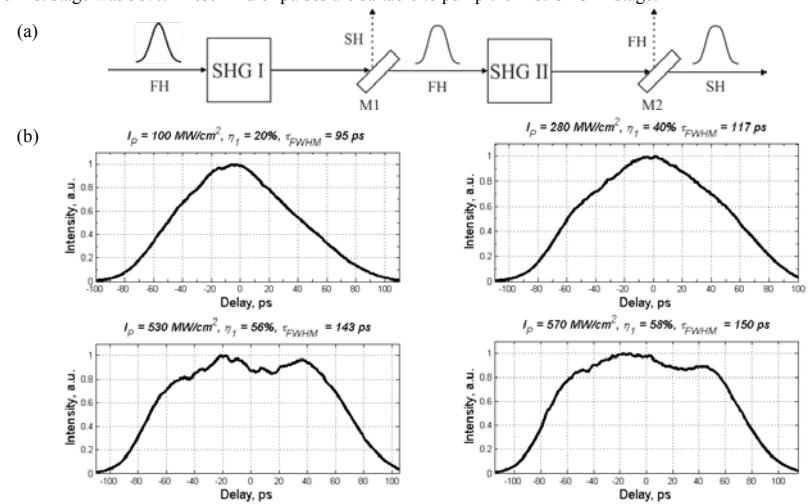
The basic principle of shape control of picosecond pulses by cascade second harmonic (SH) generation is based on three-wave interaction in the nonlinear media (see Fig. 1 (a)). At the first cascade SH generator stage fundamental harmonic (FH) pulse undergoes significant changes, which depends on the pump pulse temporal profile (in our case Gaussian shape) and SH conversion efficiency. At a certain pump intensity value FH temporal profile may become flat-top or even with a dip. Afterwards, the second cascade SH generator stage is pumped by the modified FH pulse. The temporal profile of the SH pulse generated at the second stage depends on the modified FH pulse and maintains similar temporal profile [3].
We have explored modification of picosecond pulses temporal profile by cascade SH generation (the first stage – 9 mm length LBO crystal, the second stage – 8 mm length KTP crystal). The cascade SH generator was pumped by 75 ps Gaussian shaped pulses from the 1 kHz Nd:YAG amplification system. The measurements were performed by using the modified third-order cross-correlator “Sequoia”. The SH signal was measured at the center of the beam to eliminate effects due to the beam intensity distribution. At pump intensity IP = 570 MW/cm2 formed pulse duration is about τFWHM = 150 ps, temporal range in which intensity drops 15% of its maximum value is about 105 ps, while conversion to SH efficiency at the first stage was 58%. These kind of pulses are suitable to pump the first OPCPA stage.