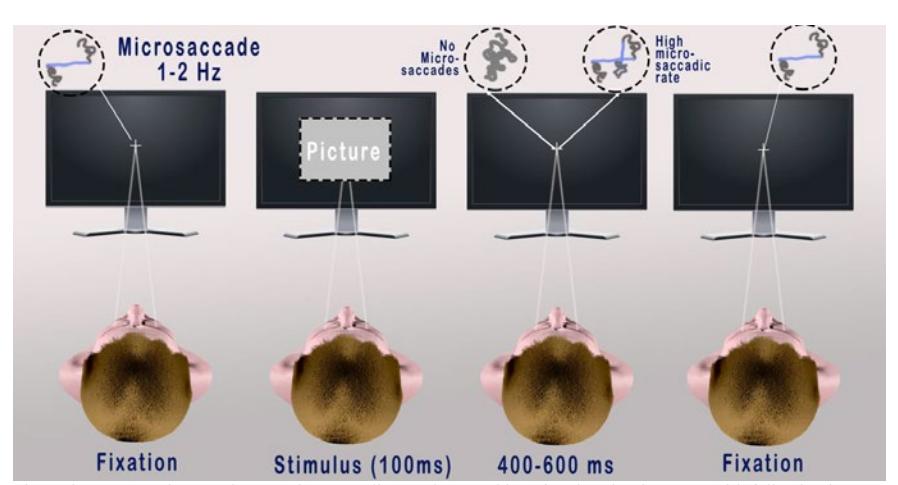
Microsaccades - the biggest and fastest fixational eye movements. It is small involuntary saccades that occur during fixation. Last decade many research works showed link between microsaccades and perception. Researches show that microsaccadic rate depends on covert attention - biphasic response with sudden drop and increase of microsaccadic rate after stimulus presentation.
Involuntary microsaccades and voluntary saccades can be an index of human brain activity in attention and oculomotor behavior tasks. The question is if they can reflect human's emotional attention. There is no accurate and objective way to evaluate quantitatively attention to emotional stimuli. Proper method would help to diagnose mental disorders.
Emotions by Charles Darwin are evolutionary adaptation because it is essential that emotional stimuli would be sensed faster than neutral stimuli. One of the theories is that we perceive emotional information faster due to attention directed to emotional stimuli which allows discriminating important information from less important. Brain structures responsible for attention displacement, emotions, microsaccades and saccades generation are connected. It would be logical to search links between these eye movements and emotional attention.
In our research we searched how reaction to emotional pictures from IAPS (International Affective Picture System) affects microsaccadic rate. We found that microsaccadic response inhibition for about 100 – 300 ms after stimulus onset and at 400 – 600 ms we found reliable difference in social unpleasant stimuli comparing to pleasant ones. Also we noticed that microsaccadic rate was lower for social stimuli. For all emotional pictures female microsaccadic rate was higher than for male suggesting that women attention to stimuli is higher than men.
Microsaccades research is a new and promising direction and it can be perspective method to explore emotional attention mechanisms.