
It is well known that the conventional CeO2 abrasive polishing techniques cause subsurface damage of fused silica (FS) glass, which is the main limiting feature of light absorption, especially in ultraviolet wavelength region of laser radiation [1-2]. Subsurface damages are defined as residual digs and scratches filled with polishing slurry and covered with the so-called Bielby layer (polished layer) [3-4].
In this study surface treatment by wet etching in fluoride-based solutions (HF/HNO3) was applied to remove Bielby layer and "clean out" digs and scratches containing residual polishing materials.
The dissolution of silicate glasses results in the formation of the stable hexafuorosilicate ($SiF_6^{2-}$) anion [5]. When hydrofluoric acid is used, the overall reaction can be summarized as:
$$SiO_2 + 6HF \rightarrow SiF_6^{2-} + 2H_2O + 2H^+\tag{1}$$Surface roughness (RMS) of polished FS substrates before and after the etching process using different HF/HNO3 solution concentrations was measured. Laser induced damage threshold (LIDT) tests (1-on-1) were used for all samples. Measurements were performed for 355 nm, 100 Hz, 4.8 ns laser radiation (Fig. 1).
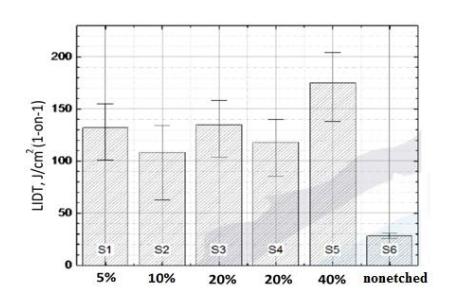
Though measured roughness of etched FS substrates was higher than the ones that were not etched, LIDT results of bare etched FS samples were successfully increased ~4 times (from 28.20 J/cm2 to 133.70 J/cm2). This could be the result of removing said subsurface damage during the etching process.