Fluorescence spectroscopy has a huge potential to be used in the field of medical diagnostics. One of the possible branches of application is diagnostics of cervical pre-cancer. To adopt spectroscopy-based technologies in medicine appropriate methods for data analysis are required for each type of medical specimen. In the previous research [1] auto-fluorescence spectra of liquid cervical smears preserved in fixation liquid called GynoPrep were investigated. Data formalization technique based on curve fitting with multiple Gaussians was implemented. Unfortunately, this method requires a bunch of subjective decisions of an investigator to be made as well as rules of convergence are not clear. To avoid these drawbacks current research is directed towards optimization of cervical smears in GynoPrep auto-fluorescence spectra analysis by means of applying more rigid methods for data formalization.
Methods. 76 auto-fluorescence spectra of medical cervical smear samples belonging to 3 medical groups (normal – no pathology found, cervicitis – inflammation of cervix, CIN2+ – pre-cancerous condition) were investigated. The medical groups were determined by histological test, which is considered to be a gold standard in medicine. Data analysis algorithms including principal component analysis (PCA) varimax rotation, multivariate curve resolution alternating least squares (MCR-Als) and mutual information based least dependent component analysis (MILCA), curve-fitting techniques were applied to extract 12 components as it was done in the earlier mentioned investigation [1]. Receiver operating characteristic (ROC) test was used to assess performance of medical group classification.
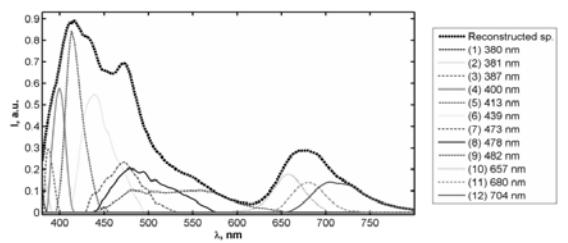
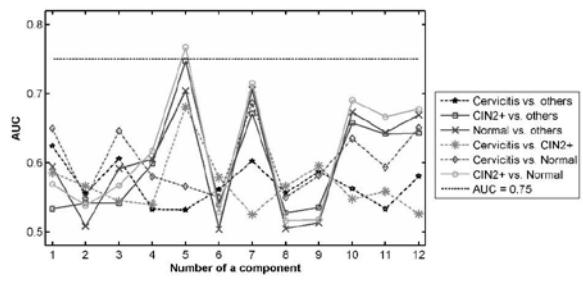
Results. The best result in terms of AUC (area under the ROC curve) acquired using combination of MCR-ALS algorithm which uses the result of PCA with varimax rotation as initial conditions. The components extracted by this method are shown in Fig.1 and the graphical representation of the results are drawn in Fig.2. As expected, the best discrimination qualities (AUC > 0.75) were achieved comparing normal and pre-cancerous CIN2+ groups.